Sandy habitats from very shallow water (less than 5 m) down to deep water of at least 200 m.
Juveniles are most frequently found in extremely shallow areas, often schooling together with clupeids
and juvenile Ectodini.
Geographic distribution:
Lake Tanganyika. Widespread throughout the lake.
Typical adult size:
Females up to about 20–20.5 cm total length; males remain much smaller, usually not exceeding 12–12.5 cm.
Sexual dimorphism:
Pronounced size dimorphism: females grow significantly larger than males.
Males show faint horizontal lines on the body, while females reach the maximum size.
Recommended aquarium size:
720 L (minimum, approx. 200 × 60 × 60 cm)
Aquarium setup:
A dimly lit aquarium with extensive open swimming space is required.
Use a fine sand substrate; rocks should be absent or very limited and always smooth.
Do not keep with aggressive species, and avoid very small tankmates which may be eaten.
Diet:
Carnivorous predator. Feeds mainly on Lake Tanganyika sardines (Stolothrissa and Limnothrissa).
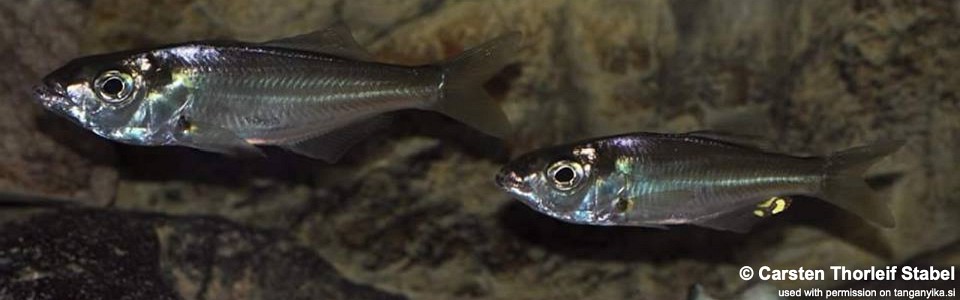
Its sardine-like appearance allows it to mingle with clupeid schools before attacking prey.
In aquaria, offer frozen foods, small live fish, small crustaceans, and other high-quality foods.
Breeding:
Maternal mouthbrooder. Adults likely move from deeper water into shallow sandy zones to spawn.
Females release the fry in shallow habitats, where juveniles remain until reaching a size of about 5 cm,
often joining schools of other shallow-water juveniles.
Aggression:
Generally peaceful toward similarly sized fishes, but smaller species will be preyed upon.
Special notes:
The only known Tanganyikan cichlid species in which females grow markedly larger than males.
Considered the most ancient species within the genus Bathybates.
Juveniles show a remarkable mimicry behaviour, resembling Trematocara species by developing
a dark patch on the anterior dorsal fin, likely as a defensive strategy.




Use a fine sand substrate; rocks should be absent or very limited and always smooth.
Do not keep with aggressive species, and avoid very small tankmates which may be eaten.
Its sardine-like appearance allows it to mingle with clupeid schools before attacking prey.
In aquaria, offer frozen foods, small live fish, small crustaceans, and other high-quality foods.
Females release the fry in shallow habitats, where juveniles remain until reaching a size of about 5 cm, often joining schools of other shallow-water juveniles.
Considered the most ancient species within the genus Bathybates.
Juveniles show a remarkable mimicry behaviour, resembling Trematocara species by developing a dark patch on the anterior dorsal fin, likely as a defensive strategy.
Photo gallery