Shallow, sediment-rich habitats, often in sheltered bays and near river mouths.
Usually found in groups at depths up to about 3 m; deeper occurrences are rare.
Water is typically turbid due to suspended sediment.
Geographic distribution:
Endemic to Lake Tanganyika.
Reported from around the entire lake, with several geographic forms known.
Typical adult size:
Up to approximately 11 cm total length.
Sexual dimorphism:
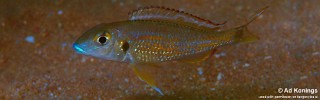
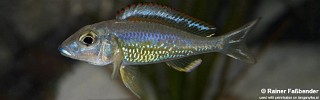
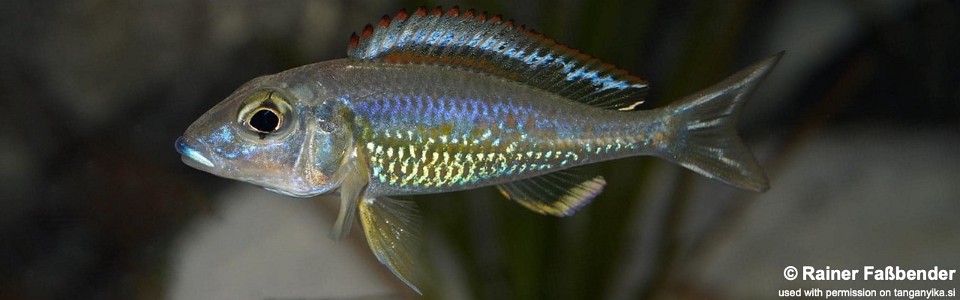
Males are larger and more colorful.
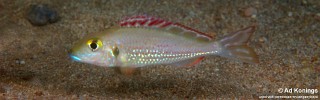
Females remain silvery throughout their lives.
Recommended aquarium size:
At least 200 L.
Aquarium setup:
Fine sand substrate is essential.
Provide rocks arranged to form caves and visual barriers.
Aquatic plants can be added to provide shelter for females.
Best kept in small groups with several males and females; aquarium length of at least 100 cm recommended.
Diet:
Carnivorous.
Feeds mainly on insects, crustaceans and other small invertebrates.
In aquaria, accepts live and frozen foods such as mysis, daphnia and cyclops.
Breeding:
Maternal mouthbrooder.
The male builds a small volcano-shaped sand nest, about 15 cm in diameter.
Male territories are spaced approximately 2–3 meters apart in nature.
Eggs are collected immediately by the female and fertilized using anal-fin egg dummies.
Brooding period lasts about 17–20 days.
Typical brood size ranges from approximately 15 to 40 fry.
Aggression:
Temperamental sand-dweller.
Less aggressive than Callochromis macrops, but males can still be combative toward each other.
Special notes:
When threatened, individuals may bury themselves in the sand for several minutes. Callochromis stappersii is considered a junior synonym of C. pleurospilus.
The name C. stappersii was historically misapplied to a Tanzanian population now referred to as
Callochromis sp. ‘pleurospilus tanzania’.
Compared to the C. macrops complex, this species is smaller, less aggressive,
and shows a lighter, more silvery breeding coloration.




Usually found in groups at depths up to about 3 m; deeper occurrences are rare.
Water is typically turbid due to suspended sediment.
Reported from around the entire lake, with several geographic forms known.
Females remain silvery throughout their lives.
Provide rocks arranged to form caves and visual barriers.
Aquatic plants can be added to provide shelter for females.
Best kept in small groups with several males and females; aquarium length of at least 100 cm recommended.
Feeds mainly on insects, crustaceans and other small invertebrates.
In aquaria, accepts live and frozen foods such as mysis, daphnia and cyclops.
The male builds a small volcano-shaped sand nest, about 15 cm in diameter.
Male territories are spaced approximately 2–3 meters apart in nature.
Eggs are collected immediately by the female and fertilized using anal-fin egg dummies.
Brooding period lasts about 17–20 days.
Typical brood size ranges from approximately 15 to 40 fry.
Less aggressive than Callochromis macrops, but males can still be combative toward each other.
Callochromis stappersii is considered a junior synonym of C. pleurospilus.
The name C. stappersii was historically misapplied to a Tanzanian population now referred to as Callochromis sp. ‘pleurospilus tanzania’.
Compared to the C. macrops complex, this species is smaller, less aggressive, and shows a lighter, more silvery breeding coloration.
Photo gallery