Open water close to rocky shores. Unlike Cyprichromis zonatus,
which inhabits deeper water, C. sp. 'kibishi' occurs mainly
within the upper 10 meters of the rocky habitat, where it is often found
together with Cyprichromis microlepidotus.
Geographic distribution:
Very restricted distribution around the Kavala Islands area, Lake
Tanganyika (Democratic Republic of Congo), especially around Kibige
Island, after which the species is named.
Typical adult size:
Males reach up to about 12 cm total length; females remain slightly
smaller.
Sexual dimorphism:
Males are larger and much more colourful than females. Females are
uniformly brownish, as typical for the genus.
Recommended aquarium size:
Minimum 350 L
Aquarium setup:
A minimum aquarium size of 350 L is recommended. The species should be
kept in groups of at least 3–4 males and at least the same number of
females. A single male often fails to develop full coloration, while
keeping only two males may result in excessive aggression between them.
With several males, aggression is better distributed and all males tend
to show good coloration. Compared to Cyprichromis leptosoma,
this species is slightly less aggressive and can be kept with most
sand-dwelling Tanganyikan cichlids.
Provide some rocks for shelter, but ensure plenty of open swimming space.
Substrate choice is not important, as the species does not feed or spawn
on the bottom.
Note: This is one of the more sensitive Cyprichromis
species (similar to C. zonatus) and requires very clean,
stable, high-quality water.
Diet:
Carnivorous planktivore. Feeds mainly on zooplankton in the wild, but
also takes small invertebrates when plankton availability is low.
Breeding:
Maternal mouthbrooder. Unlike most Cyprichromis species, males do not
maintain three-dimensional territories in open water. Spawning behavior
is similar to that of C. zonatus and C. pavo:
the male defends a site close to a vertical rock surface and leads the
female there to spawn. The female broods the eggs for approximately
three weeks before releasing the fry.
Aggression:
Intermediate. Slightly less aggressive than C. leptosoma and
C. sp. 'brilliant jumbo', but more aggressive than
C. zonatus. Males may be assertive toward tank mates of similar
size or related species.
Special notes:
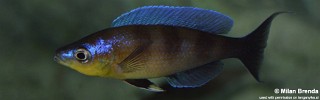
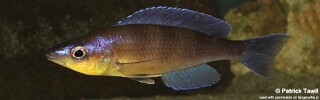
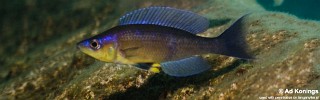
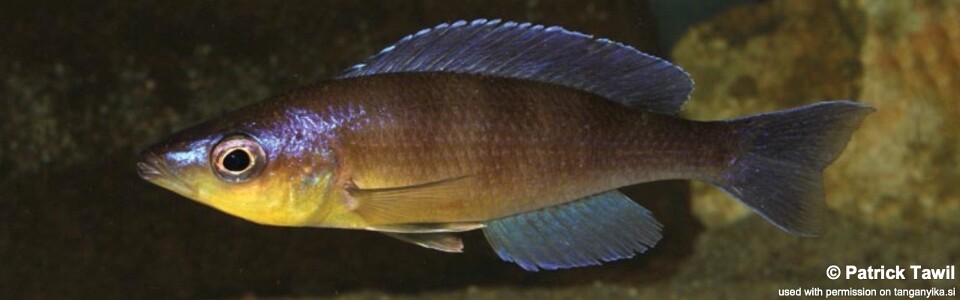
This species can be regarded as an intermediate form between
Cyprichromis zonatus and Cyprichromis leptosoma.
It resembles C. zonatus in body shape, strong vertical barring
and filamentous extensions of the caudal fin, but differs by having a
brilliant blue sheen on the head and a yellow throat and breast, similar
to C. leptosoma.
Originally considered a western-coast variant of
C. sp. 'leptosoma jumbo', it is now regarded as a distinct
species due to its coloration, body shape, lack of male polymorphism
and different breeding behavior.
Unlike most Cyprichromis species, males of C. sp. 'kibishi' are
not polymorphic within the same population—all males
share a similar coloration. This is likely related to the absence of
three-dimensional open-water territories.
In the aquarium and in nature, this species prefers the upper part of
the rocky habitat and is often found together with
Cyprichromis microlepidotus. Due to its sensitivity to poor
water quality, it is prone to wasting and death under suboptimal
conditions, even when feeding well. In the aquarium trade it is also
known as “Wimple leptosoma”.




With several males, aggression is better distributed and all males tend to show good coloration. Compared to Cyprichromis leptosoma, this species is slightly less aggressive and can be kept with most sand-dwelling Tanganyikan cichlids.
Provide some rocks for shelter, but ensure plenty of open swimming space. Substrate choice is not important, as the species does not feed or spawn on the bottom.
Note: This is one of the more sensitive Cyprichromis species (similar to C. zonatus) and requires very clean, stable, high-quality water.
Originally considered a western-coast variant of C. sp. 'leptosoma jumbo', it is now regarded as a distinct species due to its coloration, body shape, lack of male polymorphism and different breeding behavior.
Unlike most Cyprichromis species, males of C. sp. 'kibishi' are not polymorphic within the same population—all males share a similar coloration. This is likely related to the absence of three-dimensional open-water territories.
In the aquarium and in nature, this species prefers the upper part of the rocky habitat and is often found together with Cyprichromis microlepidotus. Due to its sensitivity to poor water quality, it is prone to wasting and death under suboptimal conditions, even when feeding well. In the aquarium trade it is also known as “Wimple leptosoma”.
Photo gallery