Occurs above sandy bottom in areas with sparse snail shells,
at depths between 5 and 20 m.
Geographic distribution:
Restricted to the area around Katibili Bay
on the Congolese shore of Lake Tanganyika.
Typical adult size:
Males reach up to about 7 cm total length
and are usually too large to enter snail shells.
Females remain smaller.
Sexual dimorphism:
No visible differences other than size,
with males being larger.
Recommended aquarium size:
100 L for a pair.
Aquarium setup:
Use fine sand as substrate with a few snail shells
placed on the bottom.
Adult fish live in the shells and use them for breeding.
Due to intraspecific aggression, it is recommended to keep
no more than one male per aquarium.
In sufficiently large aquaria (about 200–300 L),
it can be housed together with other Tanganyika cichlids
that occupy different areas of the tank.
Diet:
Carnivorous.
Feeds on various invertebrates and also on fry of other cichlids.
In aquarium, offer a variety of live and frozen foods
such as Artemia, Cyclops, and Mysis.
Breeding:
Both monogamy and polygyny have been observed.
The male digs a pit near one or more snail shells.
The female spawns inside a shell within the male’s territory,
while the male fertilizes the eggs from outside.
The male does not participate in brood care.
The guarding female often becomes very dark in coloration.
Aggression:
Males can be aggressive toward conspecifics.
Toward other species, aggression is mainly limited
to defense of the immediate territory
and does not involve active hunting outside it.
Special notes:
Lepidiolamprologus meeli and L. boulengeri closely resemble
Lepidiolamprologus attenuatus,
but unlike that species and L. sp. ‘meeli Kipili’,
they also breed inside snail shells
and adult females live in them.
For some time, a southern form was treated as a geographic variant
of L. meeli, but it is now regarded as a separate species
and referred to as L. sp. ‘meeli southeast’.
In the aquarium trade, this southern form is more common
and is often incorrectly labeled as L. hecqui.
The true L. hecqui is known only from its original description
based on a specimen recovered from the mouth of a catfish
and is considered a “museum species”.
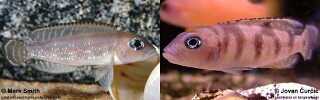
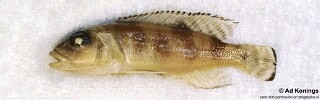
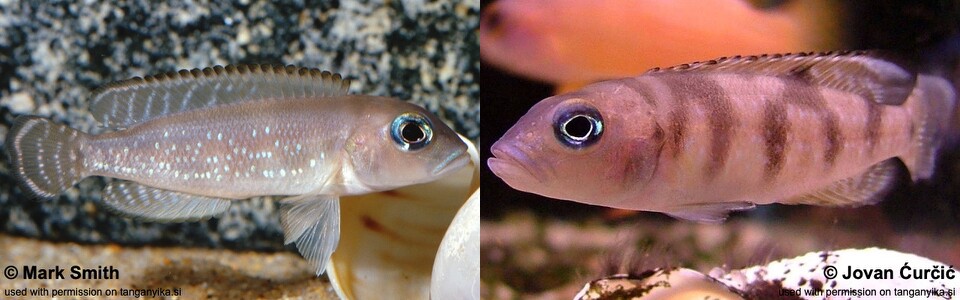




Photo gallery