Cape Kachese, 8°29'S, 30°27'E, Lake Tanganyika, Zambia.
Biotope:
Deep rocky habitat covered with sediment. Usually found at depths greater
than 20 m, but at some localities (e.g. Isanga, Zambia) also at about 10 m.
The species lives very close to rocks and almost never ventures more than
30 cm away, showing a life mode similar to Julidochromis.
Geographic distribution:
Occurs in the southern half of Lake Tanganyika. Found on the Congolese coast
south of Cape Tembwe (Deux), along the entire Zambian shoreline, and on the
Tanzanian coast up to Samazi. The species was originally described from Cape
Kachese (Zambia), with additional geographical forms reported up to Tembwe II
on the Congolese coast and Samazi on the Tanzanian side.
Typical adult size:
Males reach up to about 10 cm total length; females are smaller, usually around
7 cm.
Sexual dimorphism:
Males grow larger than females; otherwise sexual dimorphism is limited.
Recommended aquarium size:
150 L for a pair; at least 200 L for a harem.
Aquarium setup:
Use a large amount of rockwork arranged to create many passages and caves.
It is strongly recommended to stack rocks high toward the back of the
aquarium.
The species can be kept as a pair or as a harem (e.g. one male with two
females). A single established pair can be kept in a 150 L aquarium, while a
harem requires at least 200 L.
When kept with other Tanganyikan cichlids, an aquarium of at least 300 L is
required due to high aggression both within the species and toward other
cichlids.
Suitable tankmates are species occupying different zones of the aquarium,
such as more robust shell-dwellers (e.g. L. stappersi, L. ocellatus) for the
sandy bottom, and some Cyprichromis species for the midwater zone.
Avoid keeping together with similarly shaped rock-dwelling cichlids that
occupy the same niche, such as Julidochromis or Chalinochromis species.
Diet:
Carnivorous.
Feeds mainly on insect larvae, occasionally on other small invertebrates.
In the aquarium, offer a variety of live and frozen foods such as krill,
mysis, and cyclops.
Breeding:
Breeding is considered relatively difficult. Individuals are choosy when
selecting a partner, therefore it is recommended to start with a larger
group of juveniles to allow a pair to form naturally.
A cave spawner. The number of eggs is usually low, rarely more than about 20.
Both parents guard the clutch, with the female guarding the eggs inside the
cave and the male defending the area in front of the cave.
Aggression:
Extremely aggressive within the species; more than one male should not be
kept in the same aquarium.
Aggressive also toward other species. Although a pair can be kept in a
relatively small aquarium, the pair bond is not very strong and, if the bond
breaks, the male may quickly kill the female.
Special notes:
Despite being a very popular Tanganyikan cichlid, this species is relatively
rare in the lake. In terms of requirements and aggression it is very similar
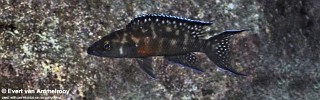
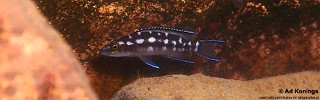
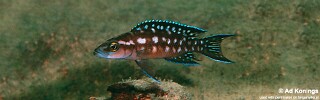
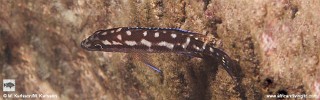
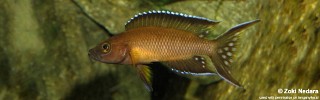
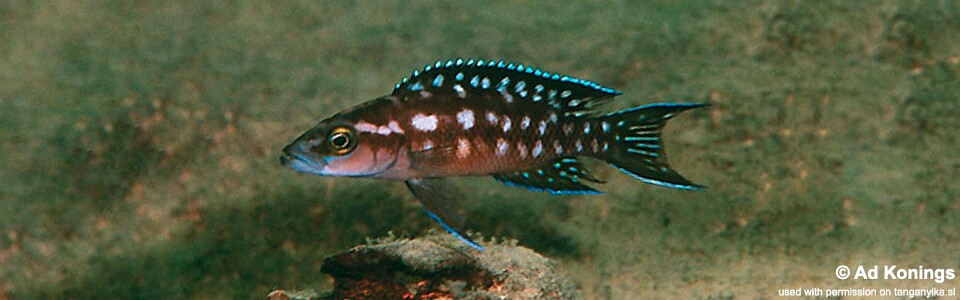
to Neolamprologus leleupi and species of the genus Julidochromis. Diagnosis: A small, elongated lamprologine species with a lunate caudal
fin and a whitish body coloration patterned by two more or less fragmented
horizontal stripes.
Although compared to Altolamprologus fasciatus in the original description, that species is not
closely related. Neolamprologus buescheri is considered closer to the
N. leleupi species group and shows similarities to N. bifasciatus and
N. longicaudatus, though differences suggest parallel evolution rather than
sibling species status.
These related species share behavioral, ecological, and morphological
similarities with Julidochromis, except for mouth shape, which is downturned
with adipose lips and reflects different feeding strategies. The melanin
pattern in N. buescheri can vary from lined to chessboard-like forms depending
on background and light conditions.




The species can be kept as a pair or as a harem (e.g. one male with two females). A single established pair can be kept in a 150 L aquarium, while a harem requires at least 200 L.
When kept with other Tanganyikan cichlids, an aquarium of at least 300 L is required due to high aggression both within the species and toward other cichlids.
Suitable tankmates are species occupying different zones of the aquarium, such as more robust shell-dwellers (e.g. L. stappersi, L. ocellatus) for the sandy bottom, and some Cyprichromis species for the midwater zone.
Avoid keeping together with similarly shaped rock-dwelling cichlids that occupy the same niche, such as Julidochromis or Chalinochromis species.
Feeds mainly on insect larvae, occasionally on other small invertebrates. In the aquarium, offer a variety of live and frozen foods such as krill, mysis, and cyclops.
A cave spawner. The number of eggs is usually low, rarely more than about 20. Both parents guard the clutch, with the female guarding the eggs inside the cave and the male defending the area in front of the cave.
Aggressive also toward other species. Although a pair can be kept in a relatively small aquarium, the pair bond is not very strong and, if the bond breaks, the male may quickly kill the female.
Diagnosis: A small, elongated lamprologine species with a lunate caudal fin and a whitish body coloration patterned by two more or less fragmented horizontal stripes.
Although compared to Altolamprologus fasciatus in the original description, that species is not closely related. Neolamprologus buescheri is considered closer to the N. leleupi species group and shows similarities to N. bifasciatus and N. longicaudatus, though differences suggest parallel evolution rather than sibling species status.
These related species share behavioral, ecological, and morphological similarities with Julidochromis, except for mouth shape, which is downturned with adipose lips and reflects different feeding strategies. The melanin pattern in N. buescheri can vary from lined to chessboard-like forms depending on background and light conditions.
Photo gallery