Cape Tembwe, Democratic Republic of Congo, Lake Tanganyika.
Biotope:
Lives in areas with groups of empty snail shells, usually collected by the
much larger Lamprologus callipterus. The species is not large or strong
enough to move shells itself and therefore lives in close association with
L. callipterus.
Shell groups are typically located near rocks, where L. callipterus also
resides. Most shell beds occur at depths around 10 m, but the species can
also be found much deeper, down to about 40 m.
Geographic distribution:
Occurs throughout Lake Tanganyika.
Typical adult size:
Males grow much larger than females. Territorial males reach about 9 cm total
length in the lake and up to around 11 cm in aquaria. Females are rarely
longer than about 5 cm, although in captivity they may reach up to roughly
7 cm.
Sexual dimorphism:
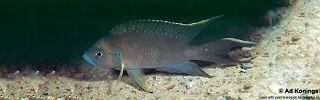
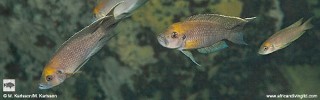
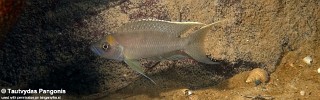
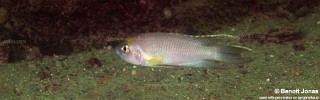
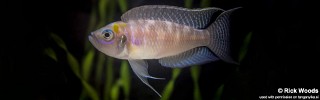
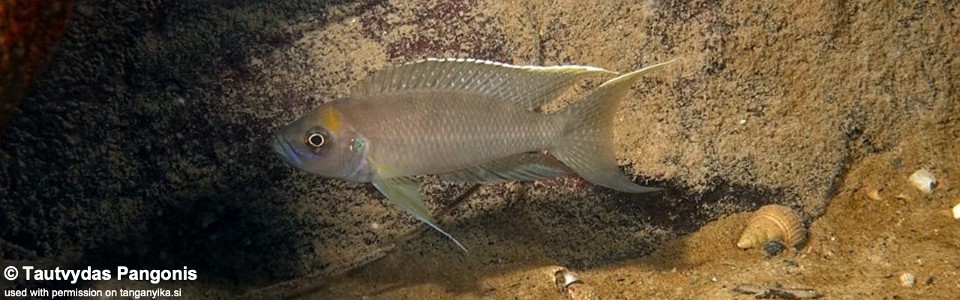
Apart from size differences, sexual dimorphism is limited. Adult males may
show more intense coloration and develop a crescent-shaped tail with
filamentous extensions, while females are generally paler.
Recommended aquarium size:
100 L for one male with several females.
Aquarium setup:
Provide some rocks for shelter and structure. The bottom should be covered
with fine sand, with empty snail shells placed on top.
To closely mimic natural behavior, shells should not be oversized. The most
suitable are shells of the Tanganyikan snail Neothauma. Other shells can
be used, but they must be small enough that only females can enter. If shells
are too large, the male may enter a shell containing guarded fry and may even
eat them.
This species lives in harems, therefore one male should be kept with several
females (three or more). In the lake, a male typically controls a much larger
harem, on average around 12 females.
They are suitable for community aquaria. The male defends the territory over
the shell group but is otherwise relatively tolerant of other cichlids.
Suitable tankmates include species from genera such as Cyprichromis and
Xenotilapia.
Diet:
Feeds primarily on zooplankton.
Because nearby rocks reduce the flow of plankton above shell beds, this
species often moves away from the shells to obtain sufficient food.
Non-territorial males therefore form larger groups while feeding in the water
column, which reduces predation risk.
Females usually remain closer to the shells and feed mainly on small
invertebrates in their vicinity.
In the aquarium, offer a variety of live and frozen foods such as Cyclops,
Artemia, Daphnia, and other small invertebrates.
Breeding:
Breeds inside empty snail shells. Females remain in or near a shell, while the
male defends a territory over a group of shells and maintains control over
his harem.
Spawning begins when the female attracts the male to her shell. Because the
male is too large to enter, fertilization occurs when he releases milt
directly into the shell opening.
Like L. callipterus, this species practices polygyny and mates with several
females. Dwarf or sneaker males may exploit the absence of the dominant male
and fertilize eggs opportunistically.
Brood size is usually between about 25 and 50 fry.
Aggression:
Aggression is mainly limited to territorial defense around the shell beds.
Outside the defended area, the species is relatively peaceful and well suited
for community aquaria.
Special notes:
Some authors have suggested that
Neolamprologus calliurus and N. brevis are the same species. Ad Konings
rejects this view, noting that males of N. brevis never reach the size
typical of N. calliurus (8–10 cm) and lack the characteristic crescent-shaped
tail. Behavioral differences are also clear: N. brevis forms pairs and both
sexes share a shell, whereas N. calliurus lives in harems.
Distinguished from most small lamprologines by a relatively
high number of gill rakers (18–21 on the lower outer gill arch). It closely
resembles N. brevis in coloration, but males of N. calliurus always have a
crescent-shaped tail, often with long filaments, and both sexes show a bright
orange patch on the nape behind the eye.
The species is strongly associated with
Lamprologus callipterus, which creates and controls large shell beds. The
presence of N. calliurus may reduce predation pressure on the offspring of
L. callipterus by diluting predation risk.




Shell groups are typically located near rocks, where L. callipterus also resides. Most shell beds occur at depths around 10 m, but the species can also be found much deeper, down to about 40 m.
To closely mimic natural behavior, shells should not be oversized. The most suitable are shells of the Tanganyikan snail Neothauma. Other shells can be used, but they must be small enough that only females can enter. If shells are too large, the male may enter a shell containing guarded fry and may even eat them.
This species lives in harems, therefore one male should be kept with several females (three or more). In the lake, a male typically controls a much larger harem, on average around 12 females.
They are suitable for community aquaria. The male defends the territory over the shell group but is otherwise relatively tolerant of other cichlids. Suitable tankmates include species from genera such as Cyprichromis and Xenotilapia.
Because nearby rocks reduce the flow of plankton above shell beds, this species often moves away from the shells to obtain sufficient food. Non-territorial males therefore form larger groups while feeding in the water column, which reduces predation risk.
Females usually remain closer to the shells and feed mainly on small invertebrates in their vicinity.
In the aquarium, offer a variety of live and frozen foods such as Cyclops, Artemia, Daphnia, and other small invertebrates.
Spawning begins when the female attracts the male to her shell. Because the male is too large to enter, fertilization occurs when he releases milt directly into the shell opening.
Like L. callipterus, this species practices polygyny and mates with several females. Dwarf or sneaker males may exploit the absence of the dominant male and fertilize eggs opportunistically.
Brood size is usually between about 25 and 50 fry.
Distinguished from most small lamprologines by a relatively high number of gill rakers (18–21 on the lower outer gill arch). It closely resembles N. brevis in coloration, but males of N. calliurus always have a crescent-shaped tail, often with long filaments, and both sexes show a bright orange patch on the nape behind the eye.
The species is strongly associated with Lamprologus callipterus, which creates and controls large shell beds. The presence of N. calliurus may reduce predation pressure on the offspring of L. callipterus by diluting predation risk.
Photo gallery