Cape Kabeyeye, East of Kasaba, south Lake Tanganyika, Zambia.
Biotope:
Lives over littoral to sub-littoral substrate in the intermediate sand-rock
zone, where it can be abundant and gather in large groups. Rounded rocks of
various sizes are typically surrounded by sand and fine gravel.
It occurs in both shallow and deeper water (more than 25 m). Where it
coexists with Neolamprologus leloupi, most N. leloupi individuals are found
at 2–10 m (rarely down to 35 m), while the opposite pattern is observed in
N. caudopunctatus: most individuals are found deeper than 10 m, with only a
few in shallower water.
Geographic distribution:
Type specimens were collected in Zambia. The species has also been found on
the Congolese coast where it coexists with N. leloupi from Lunangwa to
Kapampa.
Populations found in Tanzania have been referred to as N. sp.
‘caudopunctatus kipili’ (except for the southernmost populations), but these
are reported as not convincingly different and likely belong to the same
species.
Typical adult size:
Up to about 6–7 cm total length (around 60 mm TL is commonly reported).
Sexual dimorphism:
Sexes are essentially identical; males are usually only slightly larger than
females.
Recommended aquarium size:
100 L.
Aquarium setup:
Use fine sand as substrate with some rocks arranged to create individual
caves. Snail shells can also be added; in aquaria they may sometimes be used
as an alternative breeding site.
Suitable for Tanganyika community aquaria with other cichlids. Aggression
toward other cichlids is mainly shown during fry guarding.
Diet:
Carnivorous.
Feeds on various invertebrates taken from the substrate or in open water;
in open water it also feeds on zooplankton.
In the aquarium, offer a variety of live and frozen foods such as mysis,
krill, and Artemia.
Breeding:
In nature it breeds in caves, often created by excavating sand from beneath
rocks. In aquaria, if available, it may often use snail shells for breeding,
while in the wild this is reported as very rare because shells are usually
absent or scarce in its habitat.
Monogamous and lives in pairs. The female typically lays about 75–150 eggs.
Fry become free-swimming about one week after spawning and begin feeding on
plankton immediately.
In the wild, both parents guard the fry for about 40 days (during which the
fry grow to about 2 cm), after which they abandon them. Multi-generation
family groups have not been found in the lake for this species, unlike the
situation reported for N. savoryi.
Aquarium observations are reported as somewhat contradictory: parents often
tolerate previous generations of fry and may live together in a colony.
DNA analyses have indicated that single broods in the wild can contain fry
from other broods (reported up to about 60%). A suggested explanation is that
parents may expel certain fry when they assess that their territory is no
longer sufficiently safe.
Aggression:
Relatively peaceful, but can become quite aggressive during spawning and when
guarding fry.
Special notes:
This species is considered very similar to N. leloupi, and in some areas they
share habitat. Some have suggested they are the same species. Where they
coexist, N. leloupi is typically found in shallower water while
N. caudopunctatus is generally found deeper.
Morphologically they are very similar and are stated to be reliably separable
mainly by fin coloration: N. leloupi has a black edge on the caudal fin,
while N. caudopunctatus lacks this black edge.
The form N. sp. ‘caudopunctatus kipili’ is sometimes treated as a Tanzanian
variant of N. caudopunctatus, but Ad Konings considers it a different
species based on morphological differences.
This species is sometimes listed as a typical shell-dweller, but this is
stated to be incorrect because snail shells are absent or rare in its natural
environment and breeding normally occurs in caves.
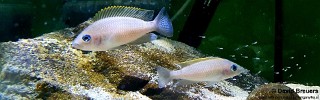
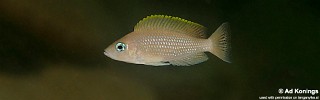
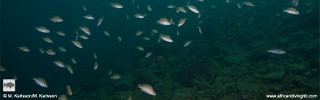
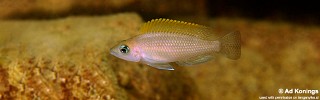
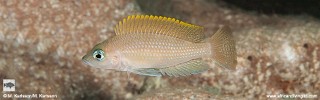
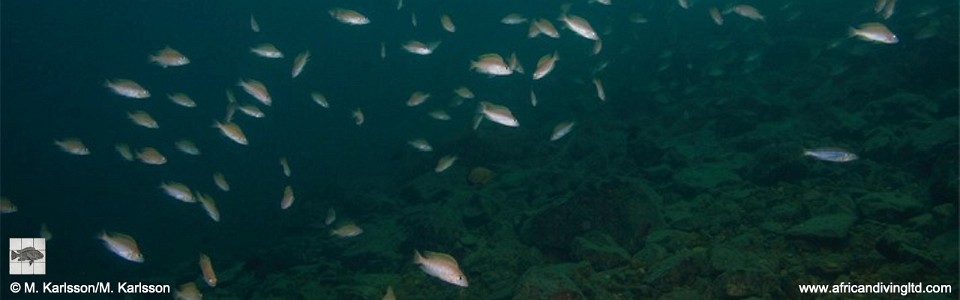




It occurs in both shallow and deeper water (more than 25 m). Where it coexists with Neolamprologus leloupi, most N. leloupi individuals are found at 2–10 m (rarely down to 35 m), while the opposite pattern is observed in N. caudopunctatus: most individuals are found deeper than 10 m, with only a few in shallower water.
Populations found in Tanzania have been referred to as N. sp. ‘caudopunctatus kipili’ (except for the southernmost populations), but these are reported as not convincingly different and likely belong to the same species.
Suitable for Tanganyika community aquaria with other cichlids. Aggression toward other cichlids is mainly shown during fry guarding.
Feeds on various invertebrates taken from the substrate or in open water; in open water it also feeds on zooplankton.
In the aquarium, offer a variety of live and frozen foods such as mysis, krill, and Artemia.
Monogamous and lives in pairs. The female typically lays about 75–150 eggs. Fry become free-swimming about one week after spawning and begin feeding on plankton immediately.
In the wild, both parents guard the fry for about 40 days (during which the fry grow to about 2 cm), after which they abandon them. Multi-generation family groups have not been found in the lake for this species, unlike the situation reported for N. savoryi.
Aquarium observations are reported as somewhat contradictory: parents often tolerate previous generations of fry and may live together in a colony.
DNA analyses have indicated that single broods in the wild can contain fry from other broods (reported up to about 60%). A suggested explanation is that parents may expel certain fry when they assess that their territory is no longer sufficiently safe.
Morphologically they are very similar and are stated to be reliably separable mainly by fin coloration: N. leloupi has a black edge on the caudal fin, while N. caudopunctatus lacks this black edge.
The form N. sp. ‘caudopunctatus kipili’ is sometimes treated as a Tanzanian variant of N. caudopunctatus, but Ad Konings considers it a different species based on morphological differences.
This species is sometimes listed as a typical shell-dweller, but this is stated to be incorrect because snail shells are absent or rare in its natural environment and breeding normally occurs in caves.
Photo gallery