Cape Bangwe on the Bangwe peninsula 5 km south of Kigoma, Tanzania (04°54'44" S, 29°35'55" E) on the east coast of Lake Tanganyika.
Biotope:
The habitat is dominated by very large boulders on a steep slope, with
sand between the stones. The species occurs at depths of about 10 to
30 m, most commonly between 10 and 20 m. Population density is low,
and individuals show strong site fidelity, using only a very small
area and rarely moving far from it.
Geographic distribution:
Described from Cape Bangwe on the Bangwe peninsula. It is most likely
restricted to this area and nearby surroundings, with confirmed
records from a single site on the peninsula.
Typical adult size:
Up to around 9 cm total length. Type material reaches 72 mm standard
length, with some individuals possibly exceeding 9 cm total length.
Sexual dimorphism:
Males are larger than females. Otherwise, external sexual dimorphism
is weak.
Recommended aquarium size:
Around 150 liters for a pair, or one male with two females.
Aquarium setup:
Use extensive rockwork arranged to create many passages and caves,
with sand on the bottom and between rocks. In larger aquaria it may
be kept in a community setup, where a pair will strongly defend its
territory.
Diet:
Carnivorous. Feeds mainly on invertebrates taken from the substrate,
biofilm, and the water column. Individuals have been observed to
ingest sediment and expel it through the mouth.
Breeding:
Low reproductive output, comparable to Neolamprologus walteri,
with roughly 10–20 fry. This is far fewer than in colonial
“princess” species such as N. brichardi or N. pulcher,
and is ecologically closer to solitary species with weak
reproductive rates.
Aggression:
Quite aggressive toward conspecifics, and toward other species mainly
when guarding fry.
Special notes:
Very similar to Neolamprologus walteri and N. falcicula,
but differs in body proportions, fin markings, and habitat
preference. It inhabits areas with large boulders and sand, while
N. walteri occurs among smaller rocks and rubble. It lacks
opercular markings and shows low reproductive output. Some
populations farther south that have been attributed to this species
are considered distinct and likely undescribed.
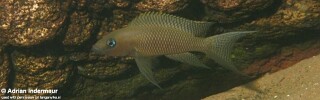
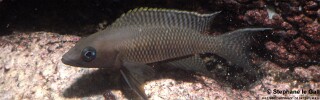
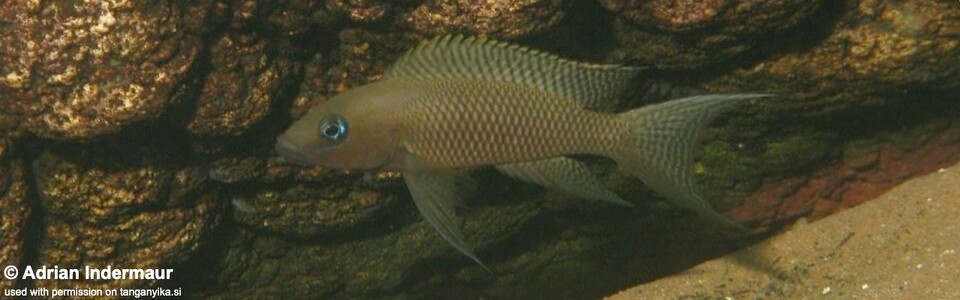




Photo gallery