Bay of Luhanga [Masanza near Cape Kapampa, written in the holotype label], westcoast of Lake Tanganyika, Zaire [Democratic Republic of Congo].
Biotope:
Rocky habitat, recorded from depths of about 4–20 m, with the highest
densities typically observed between 7 and 15 m.
Geographic distribution:
The area where this variant occurs is reported as being between the
Lunangwa River and Katete. The holotype label mentions Bay of
Luhanga (Masanza near Cape Kapampa) on the west coast of Lake
Tanganyika in the Democratic Republic of Congo, but this locality
has been questioned, and the name has been linked by some authors
to the trade form known as “black brichardi” from the Cape Chipimbi
area in Zambia.
Typical adult size:
Reaches around 7 cm in the lake, not counting the caudal fin filaments.
Sexual dimorphism:
Sexes are very similar in appearance; males are on average slightly
larger.
Recommended aquarium size:
200 L. For maintaining a larger colony, 300 L or more is recommended.
Aquarium setup:
Use fine sand as substrate and arrange rocks to create a rocky
environment with many caves and passages. When a pair is kept, a
colony may form quickly; in a colony a dominant male can establish
control over the group. Because the colony can expand rapidly and
the defended territory increases accordingly, this species is strongly
recommended for a species-only aquarium. Long-term cohabitation
with other Tanganyikan cichlids is discouraged.
Diet:
Carnivorous. In nature it feeds mainly on small invertebrates such as
insect larvae and copepods, taken from biofilm or from the water
just above the substrate. In the aquarium it accepts most foods, and
can be offered a variety of live and frozen items.
Breeding:
Once a pair forms, spawning occurs regularly. Each pair holds a
territory that is also defended by helpers, sometimes up to about 20,
indicating a well-organized social group. In the lake, the species is
described as sometimes monogamous and sometimes polygamous, with
a male potentially maintaining a harem of up to four females. If one
breeding partner dies, a helper may replace it according to the
group’s hierarchy. Early broods may be small, later reaching up to
about 150 eggs. Fry form colonies of mixed sizes and ages; some older
juveniles remain near the parents and assist in defense, while others
form new pairs and establish new colonies elsewhere. Although cave
spawning is typical, females in an established colony may lay eggs on
the outer cave wall, or in aquaria even on the front glass. Compared
with N. savoryi and N. helianthus, this species is noted
as highly reproductive, and aquaria can fill quickly with fry of many
different sizes.
Aggression:
Can be highly aggressive toward other species and may stand up to
considerably larger cichlids. As the colony grows, collective defense
becomes stronger, and the group may expand into space used by other
fish, leading to frequent conflicts. A species-only aquarium is
therefore strongly recommended.
Special notes:
Ad Konings has treated this form as a junior synonym of
Neolamprologus pulcher, proposing that it differs mainly by
facial pattern. The distinguishing feature described here is a single
black spot behind the eye on the gill cover area, whereas typical
N. pulcher and N. brichardi show crescent-like “((”
markings or a “T”-shaped marking. It is further argued that facial
colour patterns can be informative for separating species, and that
rapid synonymisation without complete evidence may be harmful; for
that reason this text treats N. crassus as a distinct species.
Diagnosis information provided describes a member of the
savoryi–brichardi–pulcher lyretail complex: a rather plump,
plain pale purple fish with a very blue eye, lyretail filaments tipped
white, few scales on unpaired fins, and reported meristics including
9–10 gill rakers, anal spines IV, dorsal spines XIX–XX, and 33–36
scales in the longitudinal line.
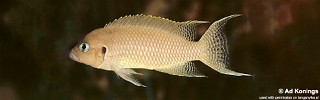
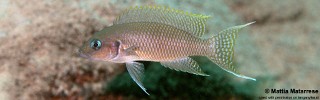
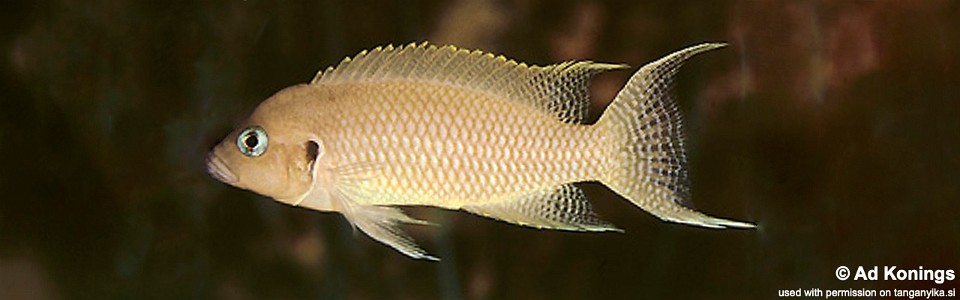




Diagnosis information provided describes a member of the savoryi–brichardi–pulcher lyretail complex: a rather plump, plain pale purple fish with a very blue eye, lyretail filaments tipped white, few scales on unpaired fins, and reported meristics including 9–10 gill rakers, anal spines IV, dorsal spines XIX–XX, and 33–36 scales in the longitudinal line.
Photo gallery