Males may reach up to 30 cm total length, while females rarely exceed
20 cm.
Sexual dimorphism:
Males are larger than females; otherwise the sexes are externally very
similar.
Recommended aquarium size:
At least 600 liters, with a recommended aquarium length of about
200 cm.
Aquarium setup:
Due to its large size, need for spacious aquaria, and relatively plain
coloration, this species is rare in aquaristics. The aquarium should
have a sandy bottom with several large and smaller rocks arranged to
form caves, which are essential for breeding. It should be kept as a
pair and only together with sufficiently large cichlids. Any smaller
fish that can fit into its mouth will be eaten.
Diet:
Carnivorous. A true predator. Juveniles feed on various planktonic
organisms, while adults are piscivorous and prey mainly on smaller
cichlids. They will consume virtually anything they can swallow,
including crustaceans. Xenotilapia species and shell-dwelling
lamprologines are frequently taken as prey.
Breeding:
A substrate spawner that breeds near rocks or shell beds, which is why
nests are often located at the edges of intermediate habitats. Spawning
takes place in a cave excavated among rocks. Breeding pairs turn very
dark brown, almost black, and are clearly distinguishable from other
individuals. Clutches may contain around 500 eggs. Once the fry become
free-swimming, they remain above the nest and feed on plankton, though
they may occasionally move several meters away together with the
parents. Juveniles have attractively colored fins, with a yellowish
dorsal fin, bluish anal fin, and a caudal fin that is yellow on the
upper part and blue on the lower part.
Aggression:
Intraspecific aggression can be pronounced. In nature the species lives
either in pairs or solitarily.
Special notes:
The largest species of the genus, characterized by a strongly elongated
body and a high number of lateral line scales. White spots on the
flanks resemble those of Neolamprologus tetracanthus, but are
smaller; fins are shorter and lack conspicuous edgings, and the caudal
fin is truncated rather than rounded. The species shows intermediate
features between Neolamprologus and Lepidiolamprologus.
Although once placed in Lepidiolamprologus due to scale
characteristics and caudal shape, it lacks the ossified labial
ligament typical of that genus and was therefore later removed from
it. Despite being common in the lake, it is rarely kept in aquaria
because of its size and subdued coloration, although some local
populations show an attractive lemon-yellow hue on the upper body.
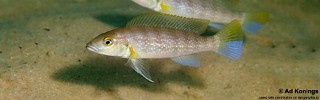
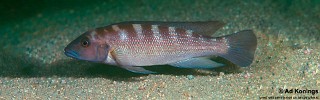
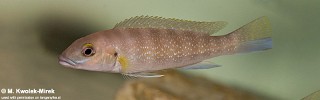
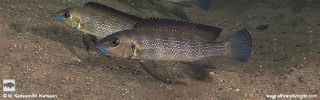
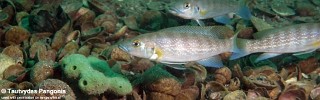
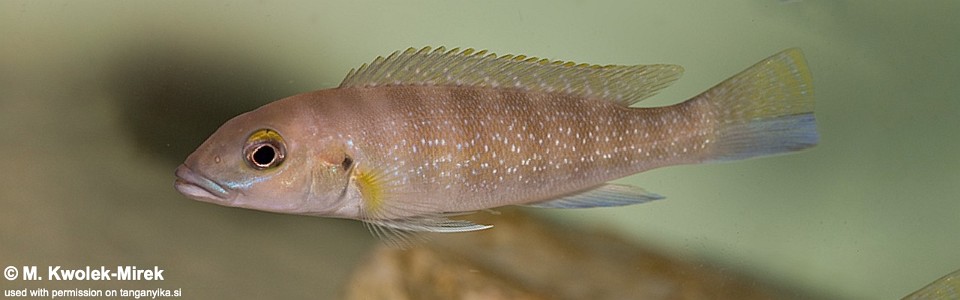




Photo gallery