Rocky habitat, typically in shallow water. Unlike N. leleupi,
N. longior, and N. mustax, it is usually found within
the upper 10 meters of the rocky zone, staying very close to rocks
and caves that provide shelter from predators and serve as breeding
sites.
Geographic distribution:
Known only from the southeastern coast of Lake Tanganyika, from Karema
in Tanzania to Kombe in Zambia.
Typical adult size:
Up to about 10 cm in the wild; in aquaria it may reach roughly 11–12 cm.
Sexual dimorphism:
Males are larger than females, with no clear external differences
otherwise.
Recommended aquarium size:
200 L for a pair.
Aquarium setup:
Provide rockwork that forms distinct caves; caves are essential because
this species repeatedly swims in and out of them and also breeds
inside them. It remains closely associated with the rocks.
Because of strong intraspecific aggression, never keep more than
one male. Best practice is one male with one female, or one male
with two females. A common approach is to start with 5–7 juveniles
and allow a pair to form (around 8 months), then remove the others.
A formed pair may be kept in an aquarium around 120 × 40 cm
(approximately 200 L), but if the pair bond breaks, a male may
quickly kill the female even in such a tank, so a larger aquarium is
recommended. For a community setup, at least 300 L is advised, or
preferably a tank length of at least 150 cm. Suitable tankmates are
other robust Tanganyika cichlids such as species from
Neolamprologus, Altolamprologus, and
Cyprichromis; avoid similarly shaped or ecologically similar
species such as N. leleupi, N. longior,
Julidochromis, and comparable fishes.
Diet:
Carnivorous. In nature it feeds mainly on invertebrates picked from
crevices among rocks. In aquaria, offer a variety of frozen and live
foods.
Breeding:
Breeds exclusively in caves; without suitable caves, spawning will not
occur. Spawning takes place in the female’s cave, where eggs are laid
on the cave wall and fertilized by the male. Clutch size is usually
around 50–100 eggs, sometimes more. The female typically remains in
the cave for a long time until the fry become free-swimming, while
the male only rarely returns to the cave after spawning.
Aggression:
Highly aggressive toward conspecifics. Toward other species it is
generally non-aggressive if the aquarium is sufficiently large, and
will mainly defend its territory around the cave.
Special notes:
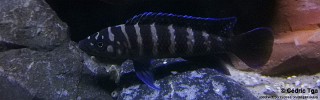
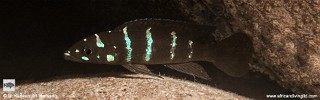
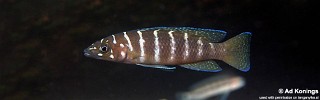
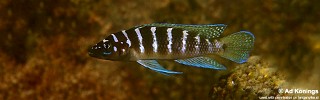
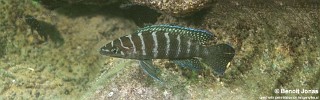
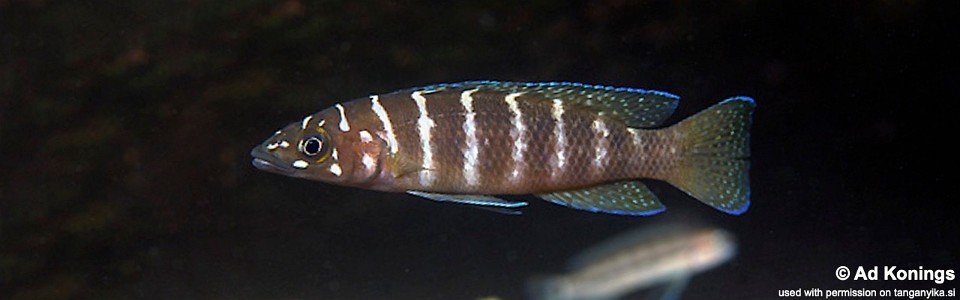
In body shape and behavior it resembles N. leleupi, and even
more N. longior, with a long and elegant body, but it
differs strongly in coloration and especially in the body pattern.
Polychromatism is described as absent; most geographic variants are
broadly similar, with one noted exception: a population from Izinga
Island described as Neolamprologus cylindricus ‘Green’,
reported to have four bars beneath the dorsal fin, whereas other
variants have five. A trade form sometimes called “Golden
cylindricus” is described by Ad Konings as most likely a hybrid
between N. longior and N. cylindricus.




Because of strong intraspecific aggression, never keep more than one male. Best practice is one male with one female, or one male with two females. A common approach is to start with 5–7 juveniles and allow a pair to form (around 8 months), then remove the others.
A formed pair may be kept in an aquarium around 120 × 40 cm (approximately 200 L), but if the pair bond breaks, a male may quickly kill the female even in such a tank, so a larger aquarium is recommended. For a community setup, at least 300 L is advised, or preferably a tank length of at least 150 cm. Suitable tankmates are other robust Tanganyika cichlids such as species from Neolamprologus, Altolamprologus, and Cyprichromis; avoid similarly shaped or ecologically similar species such as N. leleupi, N. longior, Julidochromis, and comparable fishes.
Polychromatism is described as absent; most geographic variants are broadly similar, with one noted exception: a population from Izinga Island described as Neolamprologus cylindricus ‘Green’, reported to have four bars beneath the dorsal fin, whereas other variants have five. A trade form sometimes called “Golden cylindricus” is described by Ad Konings as most likely a hybrid between N. longior and N. cylindricus.
Photo gallery