Steep, shallow rocky habitat close to the shore.
Occurs at depths of about 2–7 m. Unlike colonial
“princess” species such as Neolamprologus brichardi
and N. pulcher, this species does not form large colonies.
Geographic distribution:
Occurs along the Lake Tanganyika shoreline between
the Lunangwa River and Kalo. According to some sources,
the confirmed distribution may be restricted to a narrow
coastal band north of the Lunangwa River, while the related
Neolamprologus splendens occurs farther north.
Typical adult size:
Up to about 7 cm total length in the lake;
aquarium specimens may reach approximately 8–9 cm.
Sexual dimorphism:
Weak. Males and females are externally very similar,
males being slightly larger on average.
Recommended aquarium size:
Around 100 L for one male with one or two females.
Aquarium setup:
Provide abundant rockwork forming caves and narrow
passages, with fine sand on the bottom. Can be kept
as a pair or one male with two females. In larger aquaria,
several individuals may be kept, each defending a small
territory centered around its own shelter.
Diet:
Carnivorous. Feeds mainly on small invertebrates
such as insects, crustaceans and copepods. Stomach
analyses also revealed a minor component of vegetal
matter, including diatoms and blue or green algae.
In aquarium, accepts quality commercial foods as well
as live and frozen offerings.
Breeding:
Substrate spawner breeding throughout the year.
Pair bonds are loose; each sex occupies and defends
its own crevice, with the male visiting the female only
during spawning. Clutch size is very small compared
to colonial “princess” species. Juveniles show a spotted
pattern that fades with age.
Aggression:
Generally mild within the species. Toward other species,
aggression is mostly limited to territorial defense and
protection of fry.
Special notes:
Neolamprologus helianthus belongs to the
Neolamprologus savoryi complex and was described
by Brichard in 1997. Its taxonomic status is debated, as
some authors consider it conspecific with
Neolamprologus splendens. However, it can be
readily distinguished by its light yellow to orange
coloration, whereas N. splendens is much darker,
ranging from violet to almost black. The trade name
Neolamprologus “Kijumba” refers to this species
and does not represent a distinct taxon.
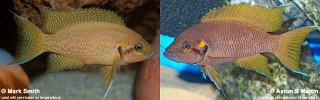
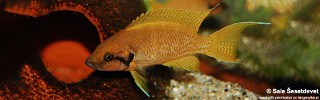
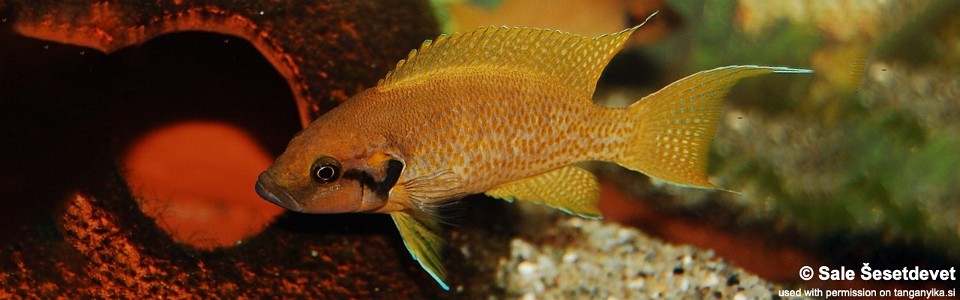




Photo gallery