At Kasenga, the species was found over sandy bottoms with scattered stones along the boundary of rocky areas. Individuals used spaces
beneath stones as shelters, and this habitat was also used for reproduction. Observations were made at approximately 20 m depth.
At Kombe, individuals occurred in fully rocky habitat and were seen moving through rocks and crevices. No reproductive behaviour was recorded
there.
Geographic distribution:
Known from the southern end of Lake Tanganyika in Zambia, with records from Kasenga and Kombe. The two sampled populations are
geographically separated but showed no detectable phylogenetic differentiation in the mitochondrial marker examined.
Typical adult size:
The examined specimens ranged from 31.1–65.5 mm standard length, with the holotype measuring 65.5 mm SL.
Sexual dimorphism:
No clear differences between males and females were detected in morphometric or meristic characters or in body coloration, apart
from the shape of the genital papilla. The largest examined female was only slightly larger than the largest examined male, and the available
material was insufficient to establish whether consistent sexual size dimorphism occurs.
Breeding:
Reproductive behaviour was documented at Kasenga on sandy substrate containing scattered stones. A female tending juveniles remained
beneath a stone and swam slowly with the abdomen directed toward its underside. The nest area was situated at approximately 20 m depth,
indicating that spaces beneath stones are used as breeding shelters.
Aggression:
During observations of the nest site, the holotype actively repelled heterospecific fishes entering the breeding area. Intruders
included a slender form of Telmatochromis temporalis and species of Mastacembelus. Smaller conspecific individuals were
observed sheltering beneath stones and were not attacked during the observations.
Special notes:
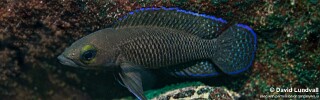
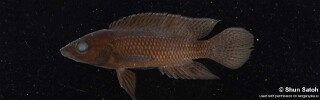
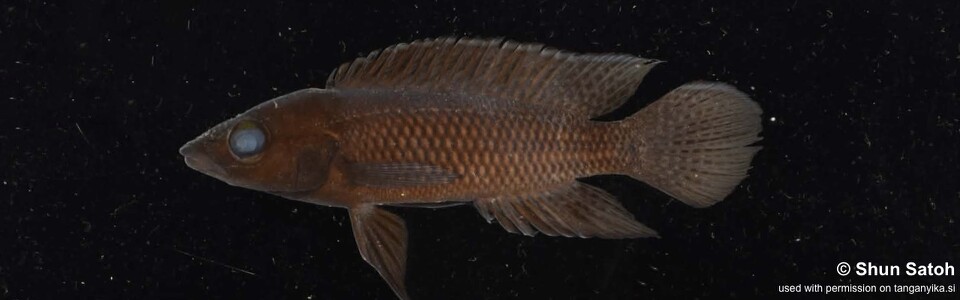
Neolamprologus labrosus is characterized most conspicuously by a strongly protruding upper lip that extends beyond the
lower lip. It also possesses a relatively slender body and a rounded caudal fin. The upper-lip projection is more pronounced than in the
morphologically similar congeners examined in the study.
Live individuals are uniformly dark brown without conspicuous markings immediately above the eye. The dorsal fin is dark brown with a narrow
black stripe along its upper margin and a whitish band directly below it. The anal fin is also dark brown, with a narrow black marginal stripe
and an adjacent whitish stripe. The caudal fin is brown with a whitish vertical marking immediately behind it, while the pectoral fins are
transparent and the pelvic fins are dark brown.
The species occurs sympatrically with N. mustax at Kasenga. Mitochondrial ND2 analysis placed N. labrosus in a clade with
N. mustax, but the two are morphologically distinct, particularly in upper-lip development, caudal-fin shape and several proportional
measurements. The Kasenga and Kombe samples showed no phylogenetic differentiation and were treated as a single species.
The name labrosus is derived from the Latin labrum, meaning lip, combined with the suffix -osus, referring to the
species' conspicuously developed and protruding upper lip.




At Kombe, individuals occurred in fully rocky habitat and were seen moving through rocks and crevices. No reproductive behaviour was recorded there.
Live individuals are uniformly dark brown without conspicuous markings immediately above the eye. The dorsal fin is dark brown with a narrow black stripe along its upper margin and a whitish band directly below it. The anal fin is also dark brown, with a narrow black marginal stripe and an adjacent whitish stripe. The caudal fin is brown with a whitish vertical marking immediately behind it, while the pectoral fins are transparent and the pelvic fins are dark brown.
The species occurs sympatrically with N. mustax at Kasenga. Mitochondrial ND2 analysis placed N. labrosus in a clade with N. mustax, but the two are morphologically distinct, particularly in upper-lip development, caudal-fin shape and several proportional measurements. The Kasenga and Kombe samples showed no phylogenetic differentiation and were treated as a single species.
The name labrosus is derived from the Latin labrum, meaning lip, combined with the suffix -osus, referring to the species' conspicuously developed and protruding upper lip.
Photo gallery