Mtoto, Lake Tanganyika, Democratic Republic of Congo
Biotope:
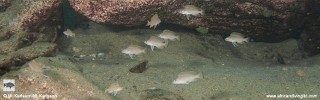
Intermediate sand–rock habitat in littoral to sub-littoral zones.
Occurs in both shallow and deep water. Where it coexists with
Neolamprologus caudopunctatus, this species is most abundant
between 2 and 10 m depth, with only isolated individuals recorded
down to about 35 m.
Geographic distribution:
Central Lake Tanganyika. Recorded from Cape Tembwe to the
Lunangwa River outlet on the Congolese coast, and from Kasoje
to Sibwesa on the Tanzanian coast.
Typical adult size:
Usually around 6 cm total length, with a maximum of about 7 cm.
Sexual dimorphism:
Very weak. Males are on average slightly larger than females,
with no clear external differences in coloration or fin shape.
Recommended aquarium size:
Around 100 L.
Aquarium setup:
Fine sand substrate with scattered stones forming caves and
crevices. Empty snail shells may also be used in aquarium as
alternative breeding sites, although shells are rare in the
natural habitat.
Well suited for Tanganyika community aquaria. Aggression toward
other species is usually limited to fry defense.
Diet:
Carnivorous. Feeds on various invertebrates taken from the
substrate as well as from open water, including zooplankton.
In aquarium, readily accepts live and frozen foods such as
mysis, krill and Artemia.
Breeding:
Monogamous, forming stable pairs. Spawning usually takes place
in caves created by digging sand from beneath stones. In
aquarium, snail shells are frequently used.
The female lays approximately 75–150 eggs. Fry become
free-swimming after about one week and immediately start
feeding on plankton. In the wild, both parents guard the fry
for roughly 40 days, after which the young are abandoned.
In nature, mixed broods containing fry from other pairs
have been documented, possibly due to parents expelling part
of their offspring when the territory becomes unsafe. In
aquarium, parents often tolerate older generations and may
form loose colonies.
Aggression:
Generally peaceful, but becomes markedly aggressive during
spawning and while guarding fry.
Special notes:
Very similar to Neolamprologus caudopunctatus, with which
it shares part of its range between Kapampa and the Lunangwa
River. Where both occur together, N. leloupi is usually
found in shallower water.
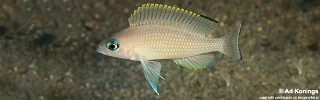
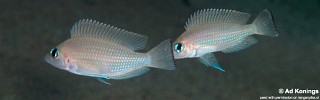
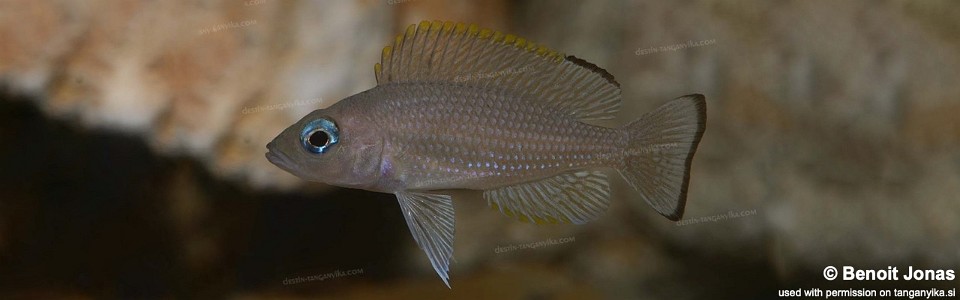
The most reliable visual distinction is the caudal fin:
N. leloupi always shows a black marginal edge, often with
a white submarginal band, whereas N. caudopunctatus
lacks this black edging.
This species is sometimes incorrectly regarded as a typical
shell-dweller; in reality, snail shells are uncommon in its
natural habitat and breeding normally takes place in caves.
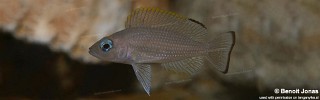
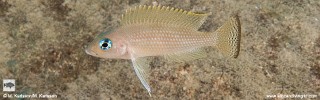
Diagnostic characters include a small size, sand-beige base
coloration without melanin pattern on the body, blue eyes, a
pointed triangular snout, and a strongly triangular caudal fin
without filamentous extensions.




Well suited for Tanganyika community aquaria. Aggression toward other species is usually limited to fry defense.
The female lays approximately 75–150 eggs. Fry become free-swimming after about one week and immediately start feeding on plankton. In the wild, both parents guard the fry for roughly 40 days, after which the young are abandoned.
In nature, mixed broods containing fry from other pairs have been documented, possibly due to parents expelling part of their offspring when the territory becomes unsafe. In aquarium, parents often tolerate older generations and may form loose colonies.
The most reliable visual distinction is the caudal fin: N. leloupi always shows a black marginal edge, often with a white submarginal band, whereas N. caudopunctatus lacks this black edging.
This species is sometimes incorrectly regarded as a typical shell-dweller; in reality, snail shells are uncommon in its natural habitat and breeding normally takes place in caves.
Diagnostic characters include a small size, sand-beige base coloration without melanin pattern on the body, blue eyes, a pointed triangular snout, and a strongly triangular caudal fin without filamentous extensions.
Photo gallery