Kabogo Point, Kibwe Bay, Lake Tanganyika, Tanzania
Biotope:
Rocky habitat rich in sediment.
Geographic distribution:
Eastern Tanzanian coast of Lake Tanganyika, south of the Malagarasi River
to the Ifume River.
Typical adult size:
Up to about 10 cm in the lake. In aquarium it may grow about 1–2 cm
larger. The maximum size given is up to 10 cm, and it may reach about
12 cm in aquarium.
Recommended aquarium size:
200 L (for a pair).
Aquarium setup:
Arrange the aquarium with many hiding places (caves). It is best to keep
only a pair, because this species is quite aggressive toward
conspecifics. It is recommended to start with several juveniles and
remove the extra individuals once a pair forms. In a sufficiently
large aquarium (preferably 300 L or more), it can be kept with other
small to medium Tanganyika cichlids such as Cyprichromis and
Altolamprologus.
Diet:
Carnivorous. Feeds mainly on crustaceans and other invertebrates found
in aufwuchs and in rock crevices. In aquarium provide quality
commercial foods and occasionally offer live and frozen foods such as
mysis and krill.
Breeding:
The pair bond is not tight; after spawning the pair often separates
after about one month, and in aquarium the male may spawn with several
females if available. Spawning takes place inside a cave owned by the
female, which she uses to lure the male. The female lays eggs on the
cave wall and the male fertilizes them. The clutch is usually 50–100
eggs (sometimes more). The female guards the eggs inside the cave,
while the male guards the area in front of the cave, but typically
leaves the female and fry within a few weeks.
Aggression:
Quite aggressive toward conspecifics. Toward other species it is usually
tolerant, but in some individuals this can change with age and they
may become aggressive toward other species as well.
Special notes:
A polychromatic species: even within the same population individuals may
differ in coloration. Coloration also varies between populations,
ranging from yellow and grey to very dark, almost black forms; the
most popular in the hobby are vivid yellow to orange fish. Although
it may be less known by name, it is very common in aquaria because
many populations have long been sold under the name N.
leleupi, following a period when Ad Konings considered
N. longior a synonym of N. leleupi. Poll described
N. longior in 1986 and it has recognized species status.
Because N. longior was exported under the name “leleupi”,
hybridization with N. leleupi likely occurred in the hobby,
and many aquarium fish labeled N. leleupi may be
N. longior or hybrids. Compared with N. leleupi,
N. longior is more slender and elongated, whereas N.
leleupi has a shorter, deeper body and may develop a small nuchal
hump with age.
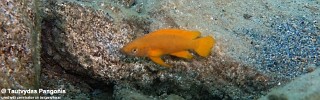
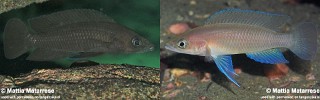
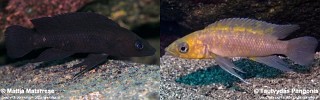
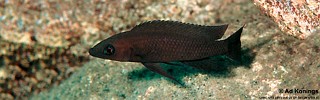
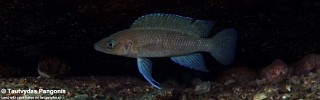
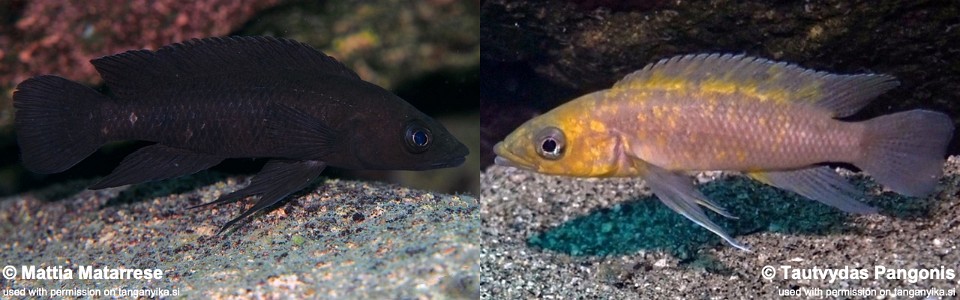




Photo gallery