Widely distributed in the northern part of Lake Tanganyika.
In the Democratic Republic of Congo it occurs from Uvira southwards
to the Lunangwa River. The species is also present along the
Burundian shoreline in the north of the lake. Further south,
its distribution continues along the Tanzanian coast down to
Segunga.
Typical adult size:
Up to approximately 12 cm total length.
Sexual dimorphism:
No clear sexual dimorphism, except that males are larger
than females.
Recommended aquarium size:
At least 200 liters for a formed pair; larger aquaria are
recommended for community setups.
Aquarium setup:
The aquarium should contain several larger rock structures
forming caves and territories, combined with a bottom layer of
fine sand. Although generally calmer than the more slender
Neolamprologus christyi, this species defends its territory
vigorously, especially while guarding eggs and fry.
Diet:
Carnivorous. Feeds mainly on various invertebrates and
occasionally on small snails. According to Ad Konings (2015),
eggs of the killifish Lamprichthys tanganicanus may also
form part of the natural diet.
Breeding:
Breeds throughout the year and is highly prolific, with
clutches ranging from approximately 200 to 500 eggs. According
to Ad Konings (2015), males often live in harems with two to five
females. In aquarium conditions, the species usually forms pairs,
with the male being relatively tolerant toward the female.
Aggression:
Considerably calmer than Neolamprologus christyi,
but nevertheless strongly territorial, especially during breeding
and while guarding eggs and fry.
Special notes:
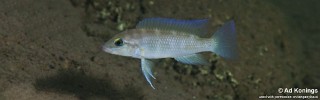
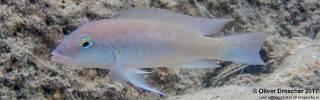
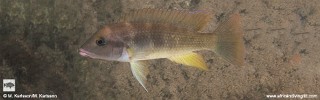
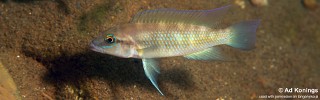
This species was long considered a synonym of
Neolamprologus modestus, as both are very similar in body
shape, coloration, behavior, and habitat. The most reliable
distinguishing character is the shape of the caudal fin: in
N. mondabu it is pointed and triangular, sometimes nearly
straight, but never rounded as in N. modestus.
Poll (1978) additionally noted that small spots present on the
caudal, anal, and dorsal fins of N. modestus are never
observed in N. mondabu.
Neolamprologus mondabu is also similar to
N. christyi and N. sp. 'eseki', but differs by
having a much less pronounced crescent-shaped caudal fin with
only short extensions. The caudal fin is always pointed, never
rounded.

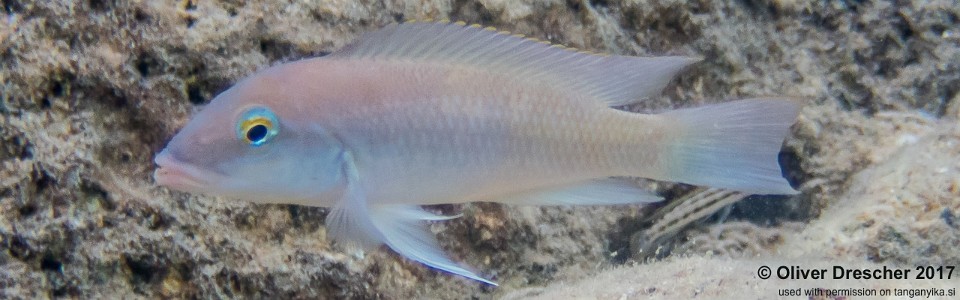




Poll (1978) additionally noted that small spots present on the caudal, anal, and dorsal fins of N. modestus are never observed in N. mondabu.
Neolamprologus mondabu is also similar to N. christyi and N. sp. 'eseki', but differs by having a much less pronounced crescent-shaped caudal fin with only short extensions. The caudal fin is always pointed, never rounded.
Photo gallery