Nyika Bay, northern Nkumbula Island, 2 km north of Mpulungu, Lake Tanganyika, Zambia
Biotope:
Inhabits deep rocky habitats and typically stays inside dark caves and crevices, rarely
seen outside them. A. Konings reports having observed this species only once in the
lake. Reported around 30 m depth, with relatively low population density.
Geographic distribution:
Found mainly along the Zambian shoreline around Mpulungu; also reported from the
northwestern Congolese coast. In the aquarium trade it is also known from Kasanga
(southern Lake Tanganyika coast near Tanzania).
Typical adult size:
Around 15 cm total length; large males can exceed 18 cm. Females remain smaller,
around 9 cm.
Sexual dimorphism:
No clear differences apart from size; males are markedly larger than females.
Recommended aquarium size:
300 L
Aquarium setup:
Use abundant rockwork to create many passages, caves, and deep crevices. Keep
lighting relatively dim. House with calmer Tanganyika cichlids that are large enough
not to be taken as prey, and avoid aggressive tankmates; due to its large but fragile
jaws and lack of thickened scales, it is a relatively weak fighter and must be handled
cautiously to prevent wounds and skin problems.
Diet:
Carnivorous; feeds mainly on small invertebrates found within dark caves in deep
rocky habitats, and may also take young fishes. Prey is captured by suction using its
very prominent jaws. Enlarged sensory canals (pores visible on the top of the head)
help locate prey in low light.
Breeding:
Spawns inside caves or deep crevices. Lives in pairs, with both parents guarding the
brood. Early spawns in aquaria may contain very few eggs (about 5), later rising to
about 50 eggs. Pairs may typically guard around 20 fry. Fry are secretive and often
remain partially hidden. Juveniles show vertical barring; this pattern may sometimes
be visible in adult females.
Aggression:
Moderately aggressive; pairs vigorously defend the cave used for breeding.
Special notes:
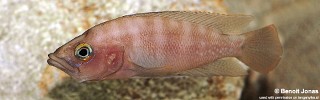
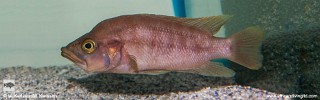
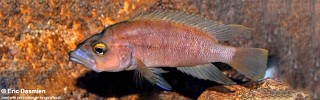
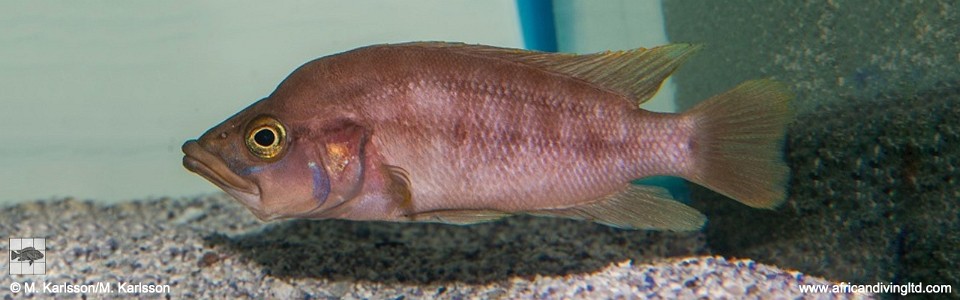
A distinctive lamprologine with a flattened, pale yellow to pink-mauve body, a
triangular head, large eye, and rounded caudal fin; the typical three longitudinal
stripes are usually only faintly visible. Characterized by extremely large, highly
protrusible jaws, with strongly projecting lower mandibular processes.
Often compared in appearance to Altolamprologus species due to convergent evolution,
but they are not closely related. Unlike Altolamprologus, it lacks thickened, hard
scales, which makes it more vulnerable to injuries and skin disease.




Often compared in appearance to Altolamprologus species due to convergent evolution, but they are not closely related. Unlike Altolamprologus, it lacks thickened, hard scales, which makes it more vulnerable to injuries and skin disease.
Photo gallery