Inhabits rocky habitats, typically found at depths between 4 and 20 m, with the
highest densities observed between 7 and 15 m.
Geographic distribution:
Occurs mainly in the southern part of Lake Tanganyika, including Zambia and
southern Tanzania. In Zambia it is found from Cape Chaitika to the Kalambo River,
with the distribution continuing beyond the Kalambo River into Tanzania up to the
Lwazi River. In Tanzania, the species is also present between Korongwe Bay and
Karema.
Typical adult size:
Approximately 9–10 cm total length.
Sexual dimorphism:
Males and females are very similar in appearance; males are on average slightly
larger.
Recommended aquarium size:
200 L
Aquarium setup:
Use fine sand as substrate and arrange rocks to simulate a rocky environment,
forming numerous caves and passages. When kept as a pair, a colony often forms
quickly. In colonies, a dominant male controls the entire group. Larger colonies
require larger aquaria (300 L or more). Due to high reproductive success and strong
territorial defense that expands with colony growth, this species is best kept in a
species-only aquarium; long-term cohabitation with other Tanganyika cichlids is
generally discouraged.
Diet:
Carnivorous; in nature feeds mainly on small invertebrates such as insect larvae
and copepods, collected from the biocover or the water column above the substrate.
In aquaria it readily accepts most foods, including live and frozen offerings.
Breeding:
Once a pair is established, breeding occurs regularly. Each pair maintains a
territory defended not only by the parents but also by helpers, which may number
up to 20 individuals. The species shows both monogamous and polygamous systems
in the lake, with males sometimes maintaining up to four females. If one breeder
dies, a helper next in hierarchy replaces it. Early spawns contain few eggs, later
increasing to as many as 150. Fry of different sizes and ages form colonies; some
remain near the parents as helpers, while others establish new pairs nearby. Although
basically cave spawners, females may deposit eggs on outer cave walls or even on
the aquarium front glass when colony defense is strong.
Aggression:
Highly aggressive toward other species; capable of confronting much larger
cichlids. Territorial defense is collective, and as the colony grows, its effective
strength and occupied area increase, often leading to conflicts. A species-only
aquarium is strongly recommended.
Special notes:
For many years N. brichardi and N. pulcher were treated as separate species. In
the late 1990s some authors began to argue they should be considered the same
species, with N. brichardi as a junior synonym of N. pulcher because N. pulcher
was described earlier. Dierkes (1999) and later Duftner (2007), based on mtDNA
analyses, also supported merging them, and Ad Konings agreed in the 3rd
edition of “Tanganyika cichlids in their natural habitat”.
It is noted that Duftner’s work was a phylogenetic study of gene hierarchy,
which is not directly focused on taxonomy, yet it contributed to the proposed
taxonomic merger.
Magnus and Mikael Karlsson later conducted a broad taxonomic analysis covering
more than 100 localities and concluded that N. brichardi and N. pulcher are
undoubtedly two distinct species, reliably separable by facial colour patterns.
This work was published in 2017 in issue 21 of Tanganika Magazyn, with an
extensive illustrated article; a shortened version also exists on the blog
“Neolamprologus pulcher and the analogy of N. brichardi”. The view that
N. brichardi and N. pulcher are two different species is now also supported by
CAS (The California Academy of Sciences).
In appearance, morphology, and behaviour the two species are very similar, but
the facial pattern is usually the most reliable distinction, with some areas
showing intermediate patterns.
Key facial distinctions described:
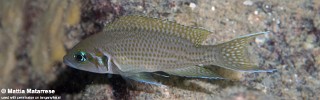
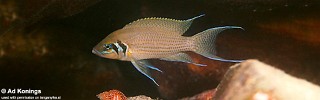
In N. brichardi, a horizontal black line from the eye to the operculum, together
with another black line along the opercular edge, forms a “T” shape.
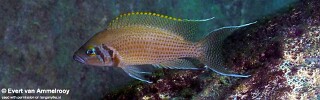
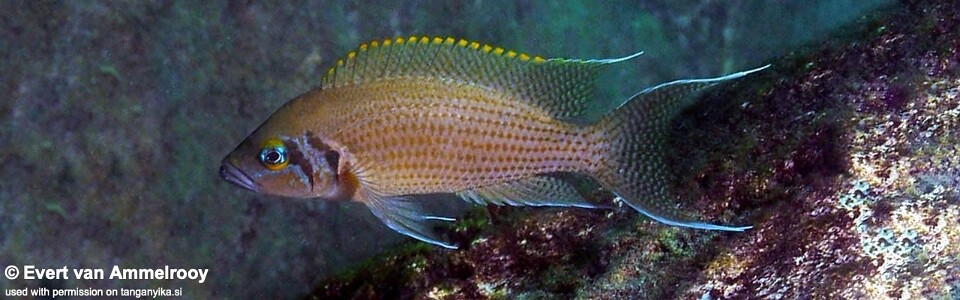
In N. pulcher, the post-ocular line turns downward rather than running
horizontally, creating a “( (” double-crescent impression with the opercular
edge line.
N. pulcher shows a yellow ring around the eye (sometimes faint); N. brichardi
lacks this ring.
The cheek (area under the eye) is unpatterned in N. pulcher, while N. brichardi
shows a pattern (often blue and yellow lines, sometimes broken, or yellow/blue
spots).
In lake observations, N. brichardi has been seen in very large groups, sometimes
over 1000 individuals; N. pulcher has not been observed in such dense aggregations
at any location.
Historically, N. brichardi was likely restricted to the northern part of the lake,
while N. pulcher inhabited the southern areas. Over time and with lake-level
fluctuations, N. brichardi also migrated south, and hybridization with N. pulcher
occurred in some regions.
The northern form of N. brichardi is often known as “Princess of Burundi”. A well
known southern N. pulcher variant is the “Daffodil”, associated with Kambwimba and
Kantalaba.






It is noted that Duftner’s work was a phylogenetic study of gene hierarchy, which is not directly focused on taxonomy, yet it contributed to the proposed taxonomic merger.
Magnus and Mikael Karlsson later conducted a broad taxonomic analysis covering more than 100 localities and concluded that N. brichardi and N. pulcher are undoubtedly two distinct species, reliably separable by facial colour patterns. This work was published in 2017 in issue 21 of Tanganika Magazyn, with an extensive illustrated article; a shortened version also exists on the blog “Neolamprologus pulcher and the analogy of N. brichardi”. The view that N. brichardi and N. pulcher are two different species is now also supported by CAS (The California Academy of Sciences).
In appearance, morphology, and behaviour the two species are very similar, but the facial pattern is usually the most reliable distinction, with some areas showing intermediate patterns.
Key facial distinctions described:
- In N. brichardi, a horizontal black line from the eye to the operculum, together
with another black line along the opercular edge, forms a “T” shape.
- In N. pulcher, the post-ocular line turns downward rather than running
horizontally, creating a “( (” double-crescent impression with the opercular
edge line.
- N. pulcher shows a yellow ring around the eye (sometimes faint); N. brichardi
lacks this ring.
- The cheek (area under the eye) is unpatterned in N. pulcher, while N. brichardi
shows a pattern (often blue and yellow lines, sometimes broken, or yellow/blue
spots).
In lake observations, N. brichardi has been seen in very large groups, sometimes over 1000 individuals; N. pulcher has not been observed in such dense aggregations at any location.Historically, N. brichardi was likely restricted to the northern part of the lake, while N. pulcher inhabited the southern areas. Over time and with lake-level fluctuations, N. brichardi also migrated south, and hybridization with N. pulcher occurred in some regions.
The northern form of N. brichardi is often known as “Princess of Burundi”. A well known southern N. pulcher variant is the “Daffodil”, associated with Kambwimba and Kantalaba.
Photo gallery