Southwestern coast of Lake Tanganyika about 5 km south of Zongwe, Democratic Republic of Congo
Biotope:
Most commonly associated with extensive shell beds, where it inhabits areas rich
in empty gastropod shells. It can also be found in rocky habitats without shells,
but in such cases only at greater depths (deeper than 25 m) and always close to
rocks. In shell-bed environments the species may occur in shallower water, around
10 m depth. Regardless of habitat type, it always lives in colonies.
Geographic distribution:
Occurs in the central part of Lake Tanganyika. On the western Congolese coast it is
found between Cape Tembwe and Kapampa; on the eastern Tanzanian coast between Cape
Kabogo and Ikola.
Typical adult size:
Males reach up to about 5 cm total length; females remain smaller, up to about
4 cm.
Sexual dimorphism:
No visible differences apart from size; females are approximately 15–25% smaller
than males.
Recommended aquarium size:
60 L
Aquarium setup:
Use a thick layer of fine sand, as the fish actively dig and move substrate. Provide
numerous empty snail shells, ideally at least one per individual, which serve as
shelter, territory, and breeding sites. Shells of the Tanganyikan snail
Neothauma are traditional, but shells of local snails may also be used.
Although the species can be kept with other small Tanganyika cichlids that are not
large enough to view it as prey, a species-only aquarium is recommended to fully
observe colony formation and expansion.
Diet:
Carnivorous; feeds mainly on planktonic copepods drifting past the shell entrance,
as well as small invertebrates found around the shells. Rock-dwelling populations
feed in a similar manner. In aquaria it readily accepts most foods, provided the
particle size is small enough for its tiny mouth.
Breeding:
Forms colonies typically composed of several males and females, each individual
occupying its own shell. In aquaria it is best to start with a group of at least
six juveniles. From this group, a pair forms or one male associates with several
females. Spawning takes place inside the female’s shell and is difficult to
observe directly; the first visible sign is usually the appearance of fry inside
the shell. Clutches are small, usually around 10–15 fry. Parents become only
slightly more aggressive than usual. Fry are fed with newly hatched Artemia and
gradually occupy nearby empty shells as they grow, expanding the colony. Older
juveniles often tolerate and help guard subsequent generations, resulting in
mixed-age colonies.
Aggression:
Generally peaceful, but despite its small size it vigorously defends its own shell
and immediate surroundings.
Special notes:
Very similar in appearance to Neolamprologus multifasciatus. The most reliable
visual difference is that N. similis shows two vertical bars extending onto
the head, whereas in N. multifasciatus the bars end before the head. Genetic
analyses indicate a very close relationship between the two species, and it has
been suggested that N. multifasciatus may have originated through
hybridisation involving N. similis and shell-dwelling relatives. Unlike
N. multifasciatus, which is mainly distributed in the southern part of the
lake, N. similis occupies the central lake region.
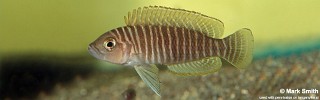
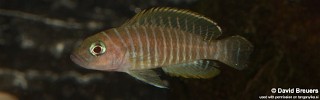
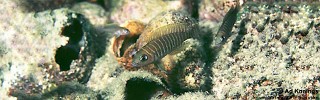
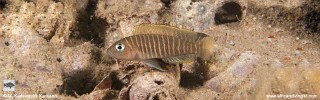
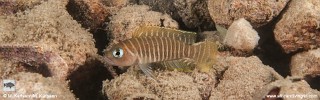
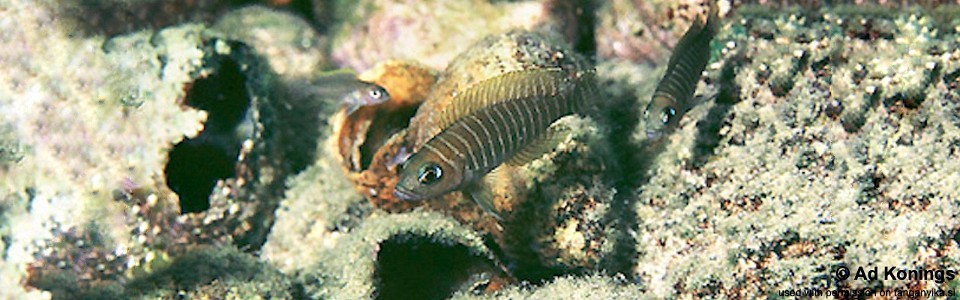




Photo gallery