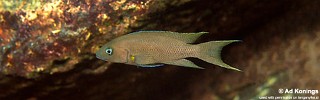
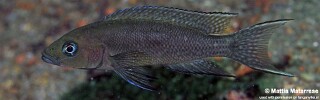
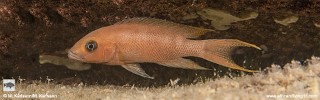
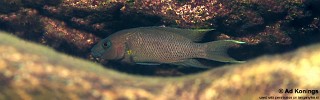
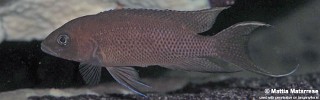
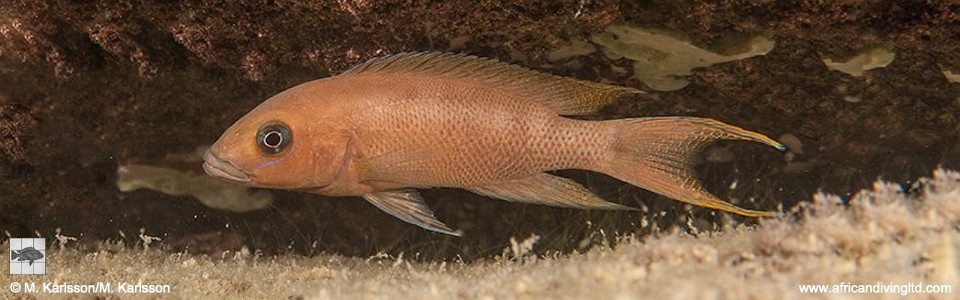
Neolamprologus sp. 'cygnus' Kisi Island Neolamprologus sp. 'cygnus orange tail' Kisi Island
Tribe / Genus:
Lamprologini / Neolamprologus
Biotope:
Primarily inhabits pure rocky habitats, in contrast to N. falcicula which
prefers intermediate zones between sand and rocks. Frequently found in shallow
water at depths of around 5 m, but its range extends down to approximately 30 m.
Compared to other “walteri-type” princesses, it commonly occupies shallower
habitats.
Geographic distribution:
Occurs along a relatively large stretch of the southern part of Lake Tanganyika on
the Tanzanian coast, ranging from Cape Mpimbwe southwards to Polombwe Bay
(Muzi).
Typical adult size:
Reaches a total length of about 9 cm.
Sexual dimorphism:
Males and females are very similar in appearance; males are usually slightly
larger.
Recommended aquarium size:
120 L (for a pair)
Aquarium setup:
The aquarium should contain abundant rockwork arranged to create numerous crevices
and caves. As a species adapted to pure rocky habitats, sand is not essential and
emphasis should be placed on stone structures. Can be kept as a pair or as one
male with two females. Due to its very low reproductive rate, it does not fill an
aquarium with juveniles as rapidly as colonial species of the brichardi complex.
In larger aquaria it may also be kept in Tanganyikan community setups, where it
will vigorously defend a relatively small territory.
Diet:
Carnivorous; feeds on various invertebrates collected from the substrate as well as
from the water column, including plankton. In aquaria it readily accepts a
variety of live and frozen foods.
Breeding:
Lives in pairs, similarly to N. falcicula and N. savoryi. Spawning takes
place in rock crevices or caves. The number of offspring is extremely low,
typically only 1–5 fry. Unlike many other princess-like species that form large
colonies or smaller social groups, this species does not live colonially and does
not form multi-generational family groups.
Aggression:
Can be aggressive toward conspecifics; aggression toward other species is mainly
expressed during territorial defense.
Special notes:
Until relatively recently, all “walteri-type” princess-like species were grouped
under N. falcicula. Subsequent studies led to the description of
N. walteri and the recognition of several closely related taxa, including
N. sp. “Cygnus”, N. chitamwebwai, and N. falcicula.
N. sp. “Cygnus” is sometimes referred to by Ad Konings as
N. sp. “falcicula cygnus”. A characteristic feature of this species group is
a dark margin on the dorsal and caudal fins; in N. sp. “Cygnus” this black
edging develops only with age, whereas juveniles often show a bicoloured
dorsal-fin margin, blue anteriorly and yellow posteriorly, which disappears as
the fish matures. Juveniles are strikingly coloured in blue and yellow, while
adult coloration varies geographically, ranging from more yellow to more orange
tones. South of Msamba, populations commonly show a yellow spot behind the gill
cover that remains visible even in adults.
The provisional name “Cygnus” derives from the Latinised Greek word for swan.
The species was discovered in 1988 by Walter Dieckhoff and later named by
Ad Konings. Early introductions to the aquarium hobby included a presentation by
Konings at the 7th international cichlid exhibition in Antwerp in 1989, followed
by exports to the USA and Sweden in 1991, and later to the Netherlands and
Germany. Specimens for these early exports were collected at Mwila Island, at the
north-eastern corner of the Kipili archipelago. Prior to export, the fish were
allowed to spawn to confirm the yellow juvenile coloration, resulting in a brood
of at least 30 juveniles in early 1991.
Geographic colour variation is pronounced along the Tanzanian range. At the
northern limit around Silaf Rocks at Cape Mpimbwe, adults may show a subtle
yellowish to reddish-yellowish head. Around the Kipili area, the Mwila Island
variant is noted for yellow pectoral fins. Further south, between Ninde and
Chisanze Point (possibly extending to Kalandasi Point near Msamba), populations
may develop an orange-brown body and an orange caudal fin, including the Kisi
Island variant; these fish may show tiny blue dots on the caudal fin, with the
caudal-fin lobes grading from orange to yellow posteriorly. In these southern
variants, the soft part of the dorsal fin may also show bright orange and
sometimes tiny blue dots.
Many variants occasionally display a bicoloured dorsal-fin margin—blue
anteriorly and yellow posteriorly—interpreted as a remnant of juvenile
coloration and not typical of fully adult fish. Juveniles and semi-adults often
show a short dark horizontal stripe behind the eye and a dark vertical stripe at
the edge of the operculum, a combination also observed in several
N. brichardi variants. South of Msamba, both juveniles and adults commonly
display a yellow pectoral spot, which becomes especially conspicuous between
Popo Point and Wampembe, including Popo Rocks and Fulwe Rocks, and is reported to
be even stronger around Molwe. In southern Kala Bay, including Kalala Island and
several islands farther south, the pectoral spot is not conspicuous and the
posterior dorsal-fin edge seen in semi-adults becomes black. Farther south
again, between Lwasase Point and the Lwazi River, a thick bright yellow margin may
adorn the posterior part of the dorsal fin and the upper part of the caudal fin.
Ontogenetic changes have been reported in some natural populations: large or old
males may develop a deeper body and a nuchal hump, confirmed in populations
between Cape Mpimbwe and Mtosi Bay. Behaviourally, N. sp. “Cygnus” does not
aggregate in schools and produces very small broods, typically 2–3 juveniles in
aquaria and rarely more than four observed with a pair in the wild, although one
documented spawn produced at least 30 juveniles. In shaded rocky habitats it may
superficially resemble N. furcifer, N. timidus, and especially
juveniles or subadults of N. christyi. Within the lake, it shares parts of
its habitat with N. savoryi, N. brichardi, and N. pulcher.




The provisional name “Cygnus” derives from the Latinised Greek word for swan. The species was discovered in 1988 by Walter Dieckhoff and later named by Ad Konings. Early introductions to the aquarium hobby included a presentation by Konings at the 7th international cichlid exhibition in Antwerp in 1989, followed by exports to the USA and Sweden in 1991, and later to the Netherlands and Germany. Specimens for these early exports were collected at Mwila Island, at the north-eastern corner of the Kipili archipelago. Prior to export, the fish were allowed to spawn to confirm the yellow juvenile coloration, resulting in a brood of at least 30 juveniles in early 1991.
Geographic colour variation is pronounced along the Tanzanian range. At the northern limit around Silaf Rocks at Cape Mpimbwe, adults may show a subtle yellowish to reddish-yellowish head. Around the Kipili area, the Mwila Island variant is noted for yellow pectoral fins. Further south, between Ninde and Chisanze Point (possibly extending to Kalandasi Point near Msamba), populations may develop an orange-brown body and an orange caudal fin, including the Kisi Island variant; these fish may show tiny blue dots on the caudal fin, with the caudal-fin lobes grading from orange to yellow posteriorly. In these southern variants, the soft part of the dorsal fin may also show bright orange and sometimes tiny blue dots.
Many variants occasionally display a bicoloured dorsal-fin margin—blue anteriorly and yellow posteriorly—interpreted as a remnant of juvenile coloration and not typical of fully adult fish. Juveniles and semi-adults often show a short dark horizontal stripe behind the eye and a dark vertical stripe at the edge of the operculum, a combination also observed in several N. brichardi variants. South of Msamba, both juveniles and adults commonly display a yellow pectoral spot, which becomes especially conspicuous between Popo Point and Wampembe, including Popo Rocks and Fulwe Rocks, and is reported to be even stronger around Molwe. In southern Kala Bay, including Kalala Island and several islands farther south, the pectoral spot is not conspicuous and the posterior dorsal-fin edge seen in semi-adults becomes black. Farther south again, between Lwasase Point and the Lwazi River, a thick bright yellow margin may adorn the posterior part of the dorsal fin and the upper part of the caudal fin.
Ontogenetic changes have been reported in some natural populations: large or old males may develop a deeper body and a nuchal hump, confirmed in populations between Cape Mpimbwe and Mtosi Bay. Behaviourally, N. sp. “Cygnus” does not aggregate in schools and produces very small broods, typically 2–3 juveniles in aquaria and rarely more than four observed with a pair in the wild, although one documented spawn produced at least 30 juveniles. In shaded rocky habitats it may superficially resemble N. furcifer, N. timidus, and especially juveniles or subadults of N. christyi. Within the lake, it shares parts of its habitat with N. savoryi, N. brichardi, and N. pulcher.
Photo gallery