Coastal rocky and intermediate habitats, typically over mixed rock-and-sand
bottoms.
Geographic distribution:
Occurs on the Tanzanian shore north of the Kipili Archipelago: recorded from the
five northernmost islands of the archipelago (Kamamba, Kasisi, Kerenge, Nkondwe,
and Mwila) and northwards along the mainland up to Isonga.
Typical adult size:
About 10–11 cm TL in the lake; in aquaria it may grow roughly 1 cm larger.
Sexual dimorphism:
Males may be slightly larger; otherwise there are no clear visual differences
between sexes.
Recommended aquarium size:
200 L (for an established pair). In community aquaria, at least 300 L is
recommended.
Aquarium setup:
Provide several larger rock piles separated into distinct structures, with fine
sand on the bottom. For an established pair, a tank of at least 200 L is advised
due to the species’ temperament; for a community tank, a substantially larger
aquarium is recommended.
Diet:
Carnivorous; feeds mainly on various invertebrates, and occasionally also on small
snails.
Breeding:
Reported as most likely similar to N. christyi. Egg numbers are described as
being in the hundreds. In captive observations referenced in the provided
material, spawns produced more than 100 fry, and a pair in the wild (Katondo,
Cape Mpimbwe) was estimated to be guarding around 100 fry.
Aggression:
Extremely aggressive toward conspecifics and also toward other species; a spacious
aquarium is required.
Special notes:
Based on observations and accounts by African Diving Ltd, Neolamprologus
sp. “Eseki” was discovered in early 1990 at the rocky shore of Udachi, southern
Tanzania. The species was initially misidentified as N. mondabu and some
of the first exported specimens were shipped under that name, before it was
recognised as a distinct taxon and introduced as N. sp. “Eseki” later the
same year.
The species inhabits shallow rocky and sandy habitats and is characterised by a
greyish to dark brown body, yellowish to yellow-brown fins, blue-green eyes, and a
slightly emarginate caudal fin with pointed corners. Certain populations, such as
those from Kansombo, Katondo, and Cape Korongwe, exhibit a black margin on the lower
part of the caudal fin, whereas populations around the Kipili Archipelago lack
this feature. N. sp. “Eseki” appears morphologically and behaviourally intermediate
between N. mondabu and N. christyi. It is more aggressive than
N. mondabu but slightly less aggressive than N. christyi, and the
shape of the caudal fin is likewise intermediate between the two species. It has
been suggested that N. sp. “Eseki” could represent a natural hybrid or a
geographical derivative of these taxa; however, African Diving Ltd consider it a
valid and distinct species based on consistent morphological characters and a
clearly delimited distribution.
Within the Kipili Archipelago, N. sp. “Eseki” is confined to the five
northern islands and does not occur sympatrically with N. christyi, which
is restricted to the three southern islands. This pattern of geographical
separation is also observed in several other cichlid species and colour variants
in the same area.
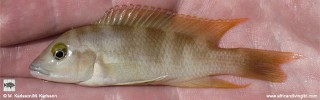
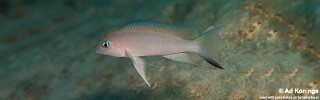
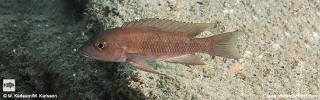
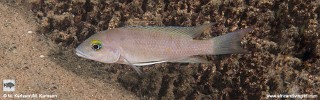
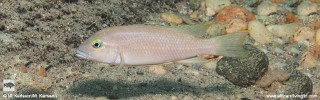
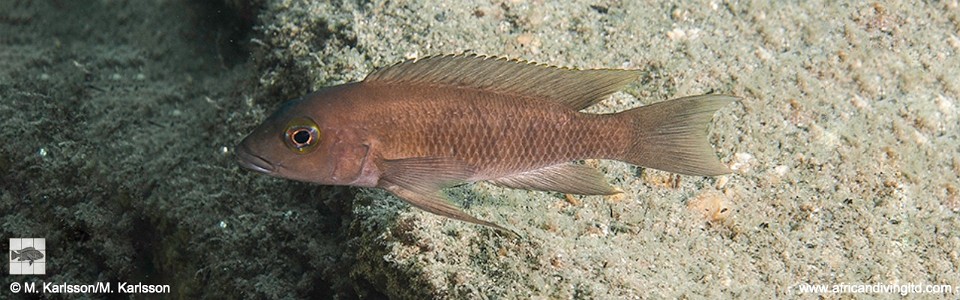




The species inhabits shallow rocky and sandy habitats and is characterised by a greyish to dark brown body, yellowish to yellow-brown fins, blue-green eyes, and a slightly emarginate caudal fin with pointed corners. Certain populations, such as those from Kansombo, Katondo, and Cape Korongwe, exhibit a black margin on the lower part of the caudal fin, whereas populations around the Kipili Archipelago lack this feature.
N. sp. “Eseki” appears morphologically and behaviourally intermediate between N. mondabu and N. christyi. It is more aggressive than N. mondabu but slightly less aggressive than N. christyi, and the shape of the caudal fin is likewise intermediate between the two species. It has been suggested that N. sp. “Eseki” could represent a natural hybrid or a geographical derivative of these taxa; however, African Diving Ltd consider it a valid and distinct species based on consistent morphological characters and a clearly delimited distribution.
Within the Kipili Archipelago, N. sp. “Eseki” is confined to the five northern islands and does not occur sympatrically with N. christyi, which is restricted to the three southern islands. This pattern of geographical separation is also observed in several other cichlid species and colour variants in the same area.
Photo gallery