Sandy, sediment-rich bottom at about 10–15 metres depth, influenced by periodic turbidity and
suspended sediment from the Mkamba River. The habitat includes clusters of empty
Neothauma tanganyicense shells, gravel, sediment layers, and numerous yellow or green
Nudospongilla moorei-like sponges.
Geographic distribution:
Mwila Island, Kipili Archipelago, Lake Tanganyika (Tanzania). The island is located roughly
500 metres east of Kerenge Island; the observed habitat is around Mwila Island at depths of
approximately 15 metres.
Typical adult size:
About 5–7 cm. Adult individuals were reported at roughly 5–6 cm total length at 15 metres
depth, and in aquarium observations adults remained around 5–7 cm.
Recommended aquarium size:
150 L.
Aquarium setup:
Use sand as the substrate and provide a large number of snail shells. Empty
Neothauma shells are preferred, but other similarly sized shells can be used. The species is
reported to remain the same size in aquaria as in the lake (about 5–7 cm).
Breeding:
Females were observed guarding offspring that shelter in empty gastropod shells, while males
patrol nearby. Recorded brood size at Mwila Island was 4–8 fry; 4–6 fry appears most common. In
aquarium observations, spawning occurred with clutches described as fewer than ten eggs and fry.
Special notes:
This form was discovered by African Diving Ltd during underwater observations at Mwila Island in the Kipili
Archipelago on 30 April 2008, where it was found at about 15 metres depth over sandy bottom with
clusters of empty Neothauma tanganyicense shells. Observed adults did not excavate sand and
were not seen taking refuge inside shells; the shells appeared to function mainly as nurseries and
shelter for the offspring. When threatened, adults darted away, temporarily leaving shells and fry.
The surrounding fish community in this habitat included Lamprologus callipterus,
T. dhonti, an N. brevis-like species with an indented caudal fin, and a
Lepidiolamprologus meeli-like species (possibly L. sp. ‘meeli-boulengeri’).
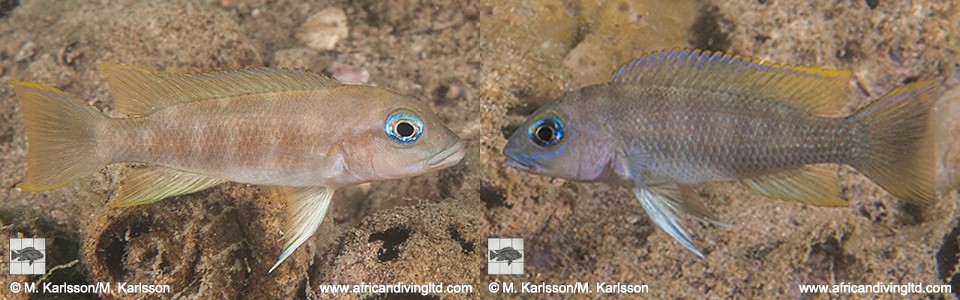
Neolamprologus sp. ‘mwila’ is described as extremely cryptic to N. sp. ‘eseki’, which
has also been observed at Mwila Island but in shallower (5–10 metres) mixed sand-and-rock habitat and
appears less common there. Both forms share a beige to brown-beige body and a similar fin pattern, but
proposed differentiating features of N. sp. ‘mwila’ include its much smaller adult size
(5–7 cm vs. 10–11 cm), a shorter body, shorter and wider snout, and a larger eye that is mainly bluish
and lacks the yellow orbital margin and the yellow patch on the upper part of the eye. The caudal fin
may also be less indented.
While N. sp. ‘mwila’ was observed with 4–8 offspring, spawning pairs of N. sp. ‘eseki’
were reported to produce an estimated 100 fry. In aquarium observations of N. sp. ‘mwila’, the
adults did not grow much larger over about a year and maintained the same proportions, which was used
as an argument that this is a distinct species rather than juveniles of N. sp. ‘eseki’.
The field observations and exports referenced in the provided text are attributed to African Diving
Ltd.




The surrounding fish community in this habitat included Lamprologus callipterus, T. dhonti, an N. brevis-like species with an indented caudal fin, and a Lepidiolamprologus meeli-like species (possibly L. sp. ‘meeli-boulengeri’).
Neolamprologus sp. ‘mwila’ is described as extremely cryptic to N. sp. ‘eseki’, which has also been observed at Mwila Island but in shallower (5–10 metres) mixed sand-and-rock habitat and appears less common there. Both forms share a beige to brown-beige body and a similar fin pattern, but proposed differentiating features of N. sp. ‘mwila’ include its much smaller adult size (5–7 cm vs. 10–11 cm), a shorter body, shorter and wider snout, and a larger eye that is mainly bluish and lacks the yellow orbital margin and the yellow patch on the upper part of the eye. The caudal fin may also be less indented.
While N. sp. ‘mwila’ was observed with 4–8 offspring, spawning pairs of N. sp. ‘eseki’ were reported to produce an estimated 100 fry. In aquarium observations of N. sp. ‘mwila’, the adults did not grow much larger over about a year and maintained the same proportions, which was used as an argument that this is a distinct species rather than juveniles of N. sp. ‘eseki’.
The field observations and exports referenced in the provided text are attributed to African Diving Ltd.
Photo gallery