Rocky habitat like other “princess” lamprologins, where they form large groups in a manner
comparable to N. brichardi and N. pulcher.
Geographic distribution:
The area between Ikola and Isonga. In this region, the only other “princess” species mentioned
is N. savoryi. Within the stretch from Ikola to the Lubulungu River, the text states there are
no native populations of N. brichardi or N. pulcher.
Sexual dimorphism:
Males and females are very similar in appearance; males are slightly larger.
Recommended aquarium size:
150 L (if the aquarium contains only a colony of this species).
Aquarium setup:
In aquaria, behaviour is described as very similar to N. brichardi and N. pulcher,
but with a smaller-bodied fish. The species quickly forms a colony and can occupy the entire aquarium,
which may lead to space limitation for other cichlids and territorial aggression; a species-only
aquarium is recommended. If kept in a community setup, the aquarium is stated to be at least 300 L.
Provide abundant rockwork arranged to create many passages and caves; it is strongly recommended to
stack rocks as high as possible toward the back of the aquarium.
Diet:
Carnivorous. In the wild they primarily feed on small invertebrates (e.g. insects and cyclops).
In the aquarium, in addition to quality commercial foods, they are given various live and frozen
foods.
Breeding:
They live and breed in colonies, described as large in a manner comparable to
N. brichardi and N. pulcher. The typical number of juveniles is stated to be about 30.
The English text also reports that both N. sp. 'princess kekese' and N. sp. 'princess lyamembe'
had a brood size of about 30 juveniles.
Special notes:
In the late 1990s and early 2000s, African Diving Ltd exported this fish under the name
N. sp. ‘Crassus Kekese’, a trade name based on a perceived resemblance to N. crassus from
the opposite Congolese coast. The species has also been repeatedly misidentified: the Karlsson
brothers (1998) initially identified it as N. gracilis; Ad Konings identified it as
N. gracilis in 1992 and later as N. marunguensis in 1998, while in his 2015 book he is
stated to regard it as a synonym of N. pulcher.
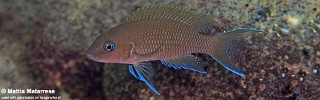
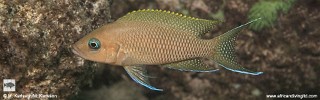
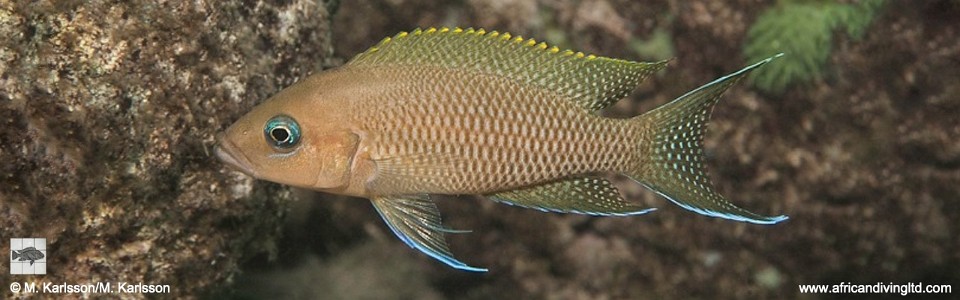
Differences versus N. sp. 'princess lyamembe': N. sp. 'princess kekese' is described as
about 2 cm smaller, yellowish beige in colour, and with a deeper body, whereas N. sp. 'princess lyamembe'
is described as greyish beige and more elongated/elegant. N. sp. 'princess kekese' is also described
as having a yellowish margin on the dorsal fin; both species have white spots on the caudal, anal,
and dorsal fins. Juveniles are described as clearly different: juveniles of N. sp. 'princess kekese'
are reported to resemble N. sp. ‘Cygnus’, with bright orange markings around the eye and operculum,
yellow fins with thin blue margins, while juveniles of N. sp. 'princess lyamembe' are described as
greyish brown, lacking yellow and orange, with conspicuous bright blue fins.
Differences versus N. crassus: N. sp. 'princess kekese' is
described as having longer, more thread-like caudal-fin lobes. N. crassus is described as having,
in contrast, a slightly deeper body, a more decreasingly sloping head profile, a conspicuous blue iris,
more yellowish caudal and anal fins, and an irregularly reticulated pattern on the posterior flank.
In addition, N. sp. 'princess kekese' is described as yellowish beige, while N. crassus is
stated to have a slate-blue coloration. Juveniles of N. sp. 'princess kekese' are described as
bright yellow and orange with partly blue fins, while N. crassus juveniles are described as mainly
beige and lacking that colouration.
Both N. sp. 'princess kekese' and N. sp. 'princess lyamembe' were
bred in a community aquarium in Dar es Salaam (1997–1998) to study juvenile colouration, and both
species were sampled during a northern Lake Tanganyika expedition in 2007–2008 and later deposited at
the Swedish Museum of Natural History in Stockholm.




Provide abundant rockwork arranged to create many passages and caves; it is strongly recommended to stack rocks as high as possible toward the back of the aquarium.
Differences versus N. sp. 'princess lyamembe': N. sp. 'princess kekese' is described as about 2 cm smaller, yellowish beige in colour, and with a deeper body, whereas N. sp. 'princess lyamembe' is described as greyish beige and more elongated/elegant. N. sp. 'princess kekese' is also described as having a yellowish margin on the dorsal fin; both species have white spots on the caudal, anal, and dorsal fins. Juveniles are described as clearly different: juveniles of N. sp. 'princess kekese' are reported to resemble N. sp. ‘Cygnus’, with bright orange markings around the eye and operculum, yellow fins with thin blue margins, while juveniles of N. sp. 'princess lyamembe' are described as greyish brown, lacking yellow and orange, with conspicuous bright blue fins.
Differences versus N. crassus: N. sp. 'princess kekese' is described as having longer, more thread-like caudal-fin lobes. N. crassus is described as having, in contrast, a slightly deeper body, a more decreasingly sloping head profile, a conspicuous blue iris, more yellowish caudal and anal fins, and an irregularly reticulated pattern on the posterior flank. In addition, N. sp. 'princess kekese' is described as yellowish beige, while N. crassus is stated to have a slate-blue coloration. Juveniles of N. sp. 'princess kekese' are described as bright yellow and orange with partly blue fins, while N. crassus juveniles are described as mainly beige and lacking that colouration.
Both N. sp. 'princess kekese' and N. sp. 'princess lyamembe' were bred in a community aquarium in Dar es Salaam (1997–1998) to study juvenile colouration, and both species were sampled during a northern Lake Tanganyika expedition in 2007–2008 and later deposited at the Swedish Museum of Natural History in Stockholm.
Photo gallery