Albertville (Kalemie), Lake Tanganyika, Democratic Republic of Congo
Biotope:
Shallow rocky and intermediate habitats, usually found down to about 10 metres depth.
Geographic distribution:
Widespread in the northern part of Lake Tanganyika. On the western shore it occurs north of
the Livua River, and on the eastern shore north of Cape Mpimbwe. It is absent only from the extreme
northern part of the lake north of Nyanza-Lac. The distribution partly overlaps with that of
N. sexfasciatus.
Typical adult size:
Up to about 14 cm in the lake; in aquaria individuals may grow slightly larger, reaching
around 15 cm.
Sexual dimorphism:
Males are noticeably larger and more robust than females; otherwise the sexes are similar.
Recommended aquarium size:
250 L for a pair.
Aquarium setup:
A sandy substrate with numerous hiding places created by rockwork. Open swimming space
should be left in the centre of the aquarium.
The species lives in pairs and is highly aggressive toward conspecifics, so even in large aquaria
only one pair should be kept. It is best maintained in a species-only aquarium, or in a large
community tank with other robust Tanganyika cichlids of similar size that occupy different areas
of the aquarium.
During breeding and brood care, a pair occupies a very large territory and defends it aggressively.
Outside the breeding period, aggression toward other species is considerably lower.
Diet:
Carnivorous. Feeds mainly on various invertebrates, but is also adapted to feeding on snails,
which it crushes using its powerful jaws and teeth. Snails make up approximately 10% of its natural
diet. In aquaria, it readily accepts a variety of live and frozen foods.
Breeding:
A monogamous species. Pairs usually remain together at least throughout the period of brood
care and often longer.
The female typically excavates a cavity beneath a rock, where the eggs are deposited out of sight.
Clutch size is large, usually around 200–300 eggs, somewhat fewer than in
N. sexfasciatus.
Both parents guard the fry: the female stays close to the brood, while the male defends the outer
boundaries of the territory. Parental care lasts for approximately four months, after which the
juveniles are expelled from the territory at a size of around 3 cm.
Aggression:
Very aggressive toward conspecifics; even in large aquaria only a single pair can be kept.
Aggression toward other species increases markedly during breeding and brood defence.
Special notes:
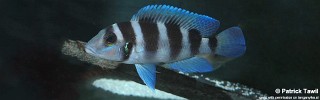
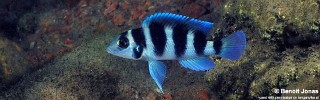
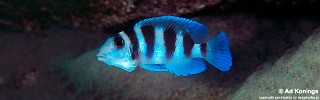
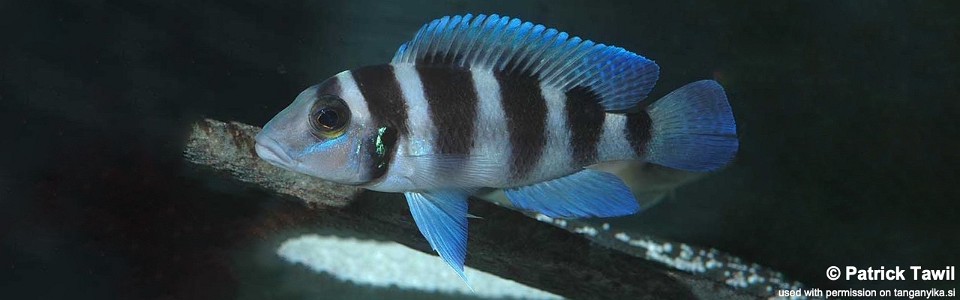
Neolamprologus tretocephalus is very similar to N. sexfasciatus, but the
two species can be readily distinguished by their vertical barring: N. tretocephalus has
five vertical bars on the body, whereas N. sexfasciatus has six.
Compared to N. sexfasciatus, N. tretocephalus occupies a considerably larger area
of the lake. The two species occur together on the western shore between the Livua River and Cape
Tembwe, and on the eastern shore between Cape Mpimbwe and Isonga.
The species is notable for its striking colour pattern, which can vary with context. The typical
barred pattern may fade to a uniform bluish-grey colour, while frightened individuals may show a
longitudinal stripe. During parental care, the vertical bars become more contrasting on the upper
half of the body.
During aggressive displays, individuals spread their opercles widely, a behaviour reminiscent of
members of the advanced N. pulcher group. Despite this, its relatively open breeding
behaviour is more similar to that of large lamprologines such as N. tetracanthus.




The species lives in pairs and is highly aggressive toward conspecifics, so even in large aquaria only one pair should be kept. It is best maintained in a species-only aquarium, or in a large community tank with other robust Tanganyika cichlids of similar size that occupy different areas of the aquarium.
During breeding and brood care, a pair occupies a very large territory and defends it aggressively. Outside the breeding period, aggression toward other species is considerably lower.
The female typically excavates a cavity beneath a rock, where the eggs are deposited out of sight. Clutch size is large, usually around 200–300 eggs, somewhat fewer than in N. sexfasciatus.
Both parents guard the fry: the female stays close to the brood, while the male defends the outer boundaries of the territory. Parental care lasts for approximately four months, after which the juveniles are expelled from the territory at a size of around 3 cm.
Compared to N. sexfasciatus, N. tretocephalus occupies a considerably larger area of the lake. The two species occur together on the western shore between the Livua River and Cape Tembwe, and on the eastern shore between Cape Mpimbwe and Isonga.
The species is notable for its striking colour pattern, which can vary with context. The typical barred pattern may fade to a uniform bluish-grey colour, while frightened individuals may show a longitudinal stripe. During parental care, the vertical bars become more contrasting on the upper half of the body.
During aggressive displays, individuals spread their opercles widely, a behaviour reminiscent of members of the advanced N. pulcher group. Despite this, its relatively open breeding behaviour is more similar to that of large lamprologines such as N. tetracanthus.
Photo gallery