Near the village Tembwe, ca. 40 km south of Moba, Lake Tanganyika, Democratic Republic of Congo
Biotope:
A deep sub-littoral habitat at around 45 metres depth. The habitat consists of steep, jagged
rocky formations with narrow vertical and horizontal crevices, terminating at approximately
60 metres depth and transitioning into sandy substrate. Observed individuals were always found
very close to the bottom.
Geographic distribution:
Only known from Tembwe (Deux), approximately 40 km south of Moba, Lake Tanganyika,
Democratic Republic of Congo.
Typical adult size:
Up to about 11 cm total length (approximately 88.5 mm standard length); females are markedly
smaller, reaching around 54.0 mm standard length.
Sexual dimorphism:
Females are significantly smaller than males; no other clear external sexual differences
have been reported.
Special notes:
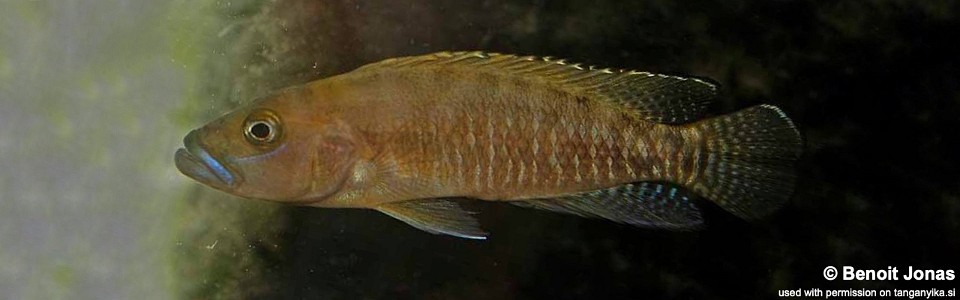
Neolamprologus variostigma is a torpedo-shaped lamprologine with short fins,
especially the pectorals, and a relatively large mouth. In overall appearance it resembles a
miniature Lepidiolamprologus, a similarity that becomes more pronounced with age.
The species is distinguished from all other members of Neolamprologus by the presence of
only four or five scale canals in the upper lateral line, a diagnostic character unknown in any
other species of the genus.
It is an extremely rare species in the wild and has been observed only twice by Heinz H. Büscher
in 1993, despite intensive searches in subsequent years. At the type locality it was found in
association with several lamprologine cichlids, including N. savoryi,
N. sexfasciatus, N. buescheri, N. gracilis,
N. splendens, N. pectoralis, N. similis,
N. bifasciatus and N. ventralis, as well as
Lamprologus lemairii, L. callipterus,
Cyphotilapia gibberosa and Xenotilapia papilio.
Juveniles closely resemble elongated Neolamprologus multifasciatus or
N. similis, sharing a similar base coloration and low vertebral count. With increasing
size, individuals progressively acquire a more pronounced Lepidiolamprologus-like
appearance, particularly in head shape, fin proportions and mottled melanin pattern.
Although no direct feeding observations are available, the morphology suggests a diet consisting
of invertebrates and possibly small fishes. According to H. Büscher,
the species is relatively prolific for a deep-water Congolese lamprologine, with clutch sizes
reported to range between approximately 80 and 200 eggs.




The species is distinguished from all other members of Neolamprologus by the presence of only four or five scale canals in the upper lateral line, a diagnostic character unknown in any other species of the genus.
It is an extremely rare species in the wild and has been observed only twice by Heinz H. Büscher in 1993, despite intensive searches in subsequent years. At the type locality it was found in association with several lamprologine cichlids, including N. savoryi, N. sexfasciatus, N. buescheri, N. gracilis, N. splendens, N. pectoralis, N. similis, N. bifasciatus and N. ventralis, as well as Lamprologus lemairii, L. callipterus, Cyphotilapia gibberosa and Xenotilapia papilio.
Juveniles closely resemble elongated Neolamprologus multifasciatus or N. similis, sharing a similar base coloration and low vertebral count. With increasing size, individuals progressively acquire a more pronounced Lepidiolamprologus-like appearance, particularly in head shape, fin proportions and mottled melanin pattern.
Although no direct feeding observations are available, the morphology suggests a diet consisting of invertebrates and possibly small fishes. According to H. Büscher, the species is relatively prolific for a deep-water Congolese lamprologine, with clutch sizes reported to range between approximately 80 and 200 eggs.
Photo gallery