Occurs mainly over sandy habitats, often in proximity to rocks.
It is frequently encountered swimming in loose hunting groups about one
meter above the substrate, but it has also been recorded at depths of up
to 250 meters.
Geographic distribution:
Lake-wide distribution along the shores of Lake Tanganyika.
Typical adult size:
Up to about 29 cm in both males and females.
Sexual dimorphism:
No visible sexual dimorphism has been reported in either size or
coloration.
Recommended aquarium size:
At least 250 liters.
Aquarium setup:
A large aquarium with open swimming space is required. Rockwork can
be included but should not dominate the layout.
Because of its scale-eating behavior and aggression, it is recommended
to keep only a single compatible pair by themselves, or to monitor
tankmates very closely during acclimatization.
Diet:
A specialized scale-eater feeding primarily on scales and pieces of
skin removed from the flanks of other fish.
Stomach-content analyses have revealed stacked rows of scales, and
occasional fish skin and fry have also been reported. Large individuals
may attack large-bodied cichlids such as Boulengerochromis microlepis,
while smaller individuals probably target smaller sand-dwelling cichlids.
Breeding:
Breeding behavior is intermediate between substrate brooding and
mouthbrooding.
Spawning takes place on sand or rock, after which the female picks up the
eggs. Clutches consist of roughly 200–300 very small eggs.
After about nine days the fry are released and guarded by both parents.
Both male and female collect and defend the fry for at least six weeks.
Aggression:
Highly aggressive toward other fish due to its lepidophagous feeding
strategy. Even conspecifics may be attacked unless a stable pair has
formed.
Special notes:
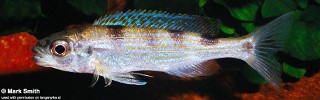
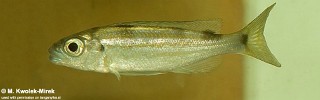
Distinguished from other scale-eating cichlids by its
combination of tooth number, fin-ray counts, and body proportions.
It has a higher number of dorsal-fin spines than Perissodus eccentricus,
a much more slender body than P. straeleni, fewer oral teeth than
P. multidentatus and P. elaviae, and more anal-fin rays than
P. elaviae.
Possibly the most common scale-eater in Lake Tanganyika and
frequently observed on dives over sandy bottoms throughout the lake.
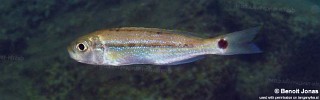
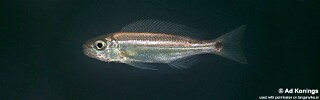
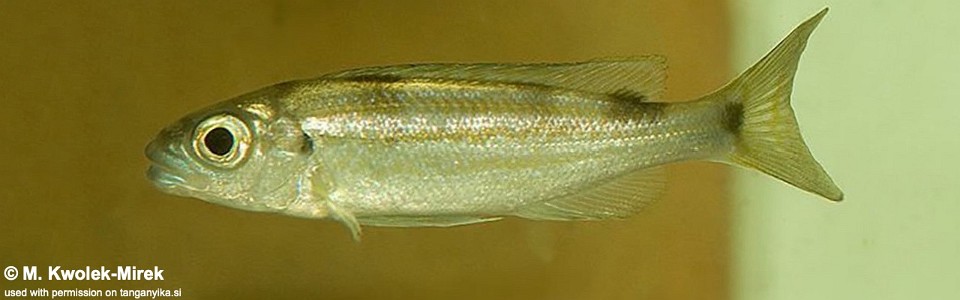
Non-breeding individuals often show a narrow mid-lateral stripe ending
at a black spot on the caudal peduncle.




It is frequently encountered swimming in loose hunting groups about one meter above the substrate, but it has also been recorded at depths of up to 250 meters.
Because of its scale-eating behavior and aggression, it is recommended to keep only a single compatible pair by themselves, or to monitor tankmates very closely during acclimatization.
Stomach-content analyses have revealed stacked rows of scales, and occasional fish skin and fry have also been reported. Large individuals may attack large-bodied cichlids such as Boulengerochromis microlepis, while smaller individuals probably target smaller sand-dwelling cichlids.
Spawning takes place on sand or rock, after which the female picks up the eggs. Clutches consist of roughly 200–300 very small eggs.
After about nine days the fry are released and guarded by both parents. Both male and female collect and defend the fry for at least six weeks.
It has a higher number of dorsal-fin spines than Perissodus eccentricus, a much more slender body than P. straeleni, fewer oral teeth than P. multidentatus and P. elaviae, and more anal-fin rays than P. elaviae.
Possibly the most common scale-eater in Lake Tanganyika and frequently observed on dives over sandy bottoms throughout the lake. Non-breeding individuals often show a narrow mid-lateral stripe ending at a black spot on the caudal peduncle.
Photo gallery