Rocky littoral zones with boulders, rocks and crevices, offering extensive grazing surfaces for algae.
Typically inhabits shallow, well-lit areas with clear, alkaline water that is low in nutrients.
Geographic distribution:
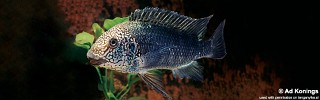
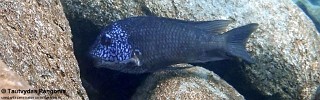
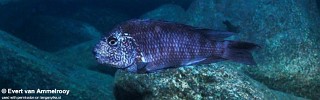
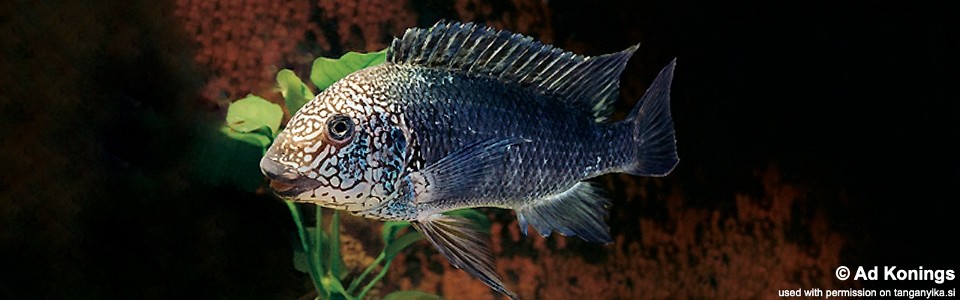
Petrochromis sp. ‘texas’ is found just inside Mahale National Park from Mankungwe Bay to the Lubulungu River; often
mislabelled in the hobby as “Texas Bulu Point”, although this form does not occur at Bulu Point.
Typical adult size:
Reaches approximately 20–21 cm total length, with males generally larger than females.
Sexual dimorphism:
Sexual dimorphism is pronounced, especially in coloration. Dominant breeding males are larger and
display vivid, geographically variable colors, while females remain uniformly dull in brown to olive tones.
Only fully dominant territorial males develop complete breeding coloration, linking size, dominance and
color expression.
Recommended aquarium size:
Smaller individuals may be kept in aquaria of around 500 L, but a minimum of 800 L is strongly
recommended for long-term maintenance due to size, aggression and territorial requirements.
Aquarium setup:
A very large aquarium with extensive rockwork forming caves, crevices and clearly defined feeding
territories, combined with a sandy substrate. Strong water movement, high oxygenation and very powerful
filtration are essential.
Water should be hard and alkaline (around pH 8.2), with stable temperatures between 23–26 °C. Bright lighting
is recommended to encourage algal growth on rock surfaces.
Diet:
Primarily herbivorous, feeding on aufwuchs consisting of algae, diatoms and associated
biofilm scraped from rocks. In aquaria, the main diet should consist of vegetable-based foods, especially
spirulina-rich flakes or pellets.
Due to its very long intestine, high-protein food must be offered only sparingly to prevent digestive
disorders.
Breeding:
This species exhibits a polygynous breeding system typical of the genus. Dominant males
establish and vigorously defend individual territories on rocky substrates, which serve both as feeding
areas and spawning sites. Females enter these territories temporarily for spawning before retreating to
brood independently.
Territorial behaviour is particularly pronounced during the breeding period. Males aggressively defend
feeding and spawning territories, often exceeding 2 m in diameter, against both conspecific and
interspecific intruders.
Spawning takes place on the substrate within the male’s territory. After external fertilization, the female
immediately collects the eggs into her mouth and leaves the territory to mouthbrood. Brooding lasts
approximately 3–4 weeks, after which the female releases free-swimming fry. Parental care is exclusively
maternal.
Aggression:
Highly aggressive and strongly territorial, particularly toward conspecifics. Males vigorously
defend feeding and breeding territories and may be lethal toward other tropheines or haplochromine cichlids
with vertical barring kept in the same aquarium.
Special notes:
This species is characterized by a large, broad and slightly downturned mouth with very
wide jaws that cannot close completely at the tips. The jaws are covered with numerous slender, tricuspid
teeth arranged in irregular bands, forming a highly efficient scraping apparatus for harvesting algae.
Compared to body length, the head and jaws are relatively short, and the caudal fin is indented.
Ecologically, it is a permanently territorial grazer inhabiting shallow rocky habitats with high light
intensity and dense algal growth. Individuals maintain and aggressively defend small feeding territories,
contributing to the spatial structuring of mixed Tropheini communities in the littoral zone.
Petrochromis sp. ‘texas’ belongs to a complex commonly referred to as the Petrochromis polyodon species
group. True P. polyodon is considered to occur south of the northern side of Kala Bay in Tanzania, along
the entire Zambian coastline and in southern Democratic Republic of the Congo, possibly extending into
central Congo. Specimens found as far north as the Lunangwa River in Congo are regarded here as true
P. polyodon, whereas populations occurring between the Lunangwa River and Kalemie are treated as
P. cf. polyodon. Polyodon-like species found north of Kalemie in Congo and north of Kala Bay in
Tanzania are regarded as potentially distinct species on this page.
Ad Konings, however, considers all of these forms to be variants of P. polyodon, including some that are not
polyodon-like and that live sympatrically with polyodon-like species. Examples include P. sp. ‘blue giant’
and P. sp. ‘longola red fin’ (also known as P. sp. ‘longnose red longola’), which are not polyodon-like in
morphology.
The Petrochromis polyodon species group is considered here to include the following possible distinct
species:
P. polyodon – found south of the northern side of Kala Bay in Tanzania, along the entire Zambian coast
and in southern Democratic Republic of the Congo to the Lunangwa River.
P. cf. polyodon – found in the southern and central parts of Democratic Republic of the Congo, between
the Lunangwa River and Kalemie.
P. sp. ‘sky blue congo’ – found between Titcha and Kavala Islands in Democratic Republic of the Congo;
resembles P. sp. ‘sky blue’ from the opposite side of the lake.
P. sp. ‘kasumbe congo’ – exact distribution unknown; according to Ad Konings possibly from Kilima to
Kibanga Bay; resembles P. sp. ‘kasumbe’ found across the lake.
P. sp. ‘texas red’ – found in northern Democratic Republic of the Congo, north of Cape Caramba; the
Ubwari Peninsula variant shows light blue head patterning and a blood-red tail, while populations from
Luhanga, Bemba and Mboko lack the red tail but are regarded by Ad Konings as the same variant.
P. sp. ‘kasumbe’ – found in the north-eastern part of the lake, between Magara (Burundi) and Halembe
(Tanzania).
P. sp. ‘sky blue’ – a polyodon-like species found north of the Lubulungu River to Magambo; distinct from
P. sp. ‘texas’ by lacking blue-spotted head patterning.
P. sp. ‘texas’ – found just inside Mahale National Park from Mankungwe Bay to the Lubulungu River; often
mislabelled in the hobby as “Texas Bulu Point”, although this form does not occur at Bulu Point.
P. sp. ‘texas isonga’ – found from Ikola northwards to Mankungwe Bay.
P. sp. ‘karema’ – found along the Ufipa Escarpment from Kalila north to Karema.
P. sp. ‘texas blue’ – found from Kabwe to Ulwile Island in the Kipili Archipelago; often confused with
P. sp. ‘blue giant’, but considered distinct here following African Diving.
P. sp. ‘texas blue neon’ – found between Ngosa Point (south of Ulwile Island) and Wampembe; also often
confused with P. sp. ‘blue giant’, but regarded here as distinct.
P. sp. ‘yellow back’ – found from Taala Point to the Izinga Island area; synonymized with P. polyodon by
Ad Konings. However, P. sp. ‘yellow back’ occurs sympatrically with P. sp. ‘blue giant’, indicating that they
cannot represent the same species (P. sp. ‘blue giant’ is not polyodon-like).
The taxonomy of this complex remains highly debated, making Petrochromis polyodon one of the most complex
and controversial taxa within the genus.




Water should be hard and alkaline (around pH 8.2), with stable temperatures between 23–26 °C. Bright lighting is recommended to encourage algal growth on rock surfaces.
Due to its very long intestine, high-protein food must be offered only sparingly to prevent digestive disorders.
Territorial behaviour is particularly pronounced during the breeding period. Males aggressively defend feeding and spawning territories, often exceeding 2 m in diameter, against both conspecific and interspecific intruders.
Spawning takes place on the substrate within the male’s territory. After external fertilization, the female immediately collects the eggs into her mouth and leaves the territory to mouthbrood. Brooding lasts approximately 3–4 weeks, after which the female releases free-swimming fry. Parental care is exclusively maternal.
Ecologically, it is a permanently territorial grazer inhabiting shallow rocky habitats with high light intensity and dense algal growth. Individuals maintain and aggressively defend small feeding territories, contributing to the spatial structuring of mixed Tropheini communities in the littoral zone.
Petrochromis sp. ‘texas’ belongs to a complex commonly referred to as the Petrochromis polyodon species group. True P. polyodon is considered to occur south of the northern side of Kala Bay in Tanzania, along the entire Zambian coastline and in southern Democratic Republic of the Congo, possibly extending into central Congo. Specimens found as far north as the Lunangwa River in Congo are regarded here as true P. polyodon, whereas populations occurring between the Lunangwa River and Kalemie are treated as P. cf. polyodon. Polyodon-like species found north of Kalemie in Congo and north of Kala Bay in Tanzania are regarded as potentially distinct species on this page.
Ad Konings, however, considers all of these forms to be variants of P. polyodon, including some that are not polyodon-like and that live sympatrically with polyodon-like species. Examples include P. sp. ‘blue giant’ and P. sp. ‘longola red fin’ (also known as P. sp. ‘longnose red longola’), which are not polyodon-like in morphology.
The Petrochromis polyodon species group is considered here to include the following possible distinct species:
- P. polyodon – found south of the northern side of Kala Bay in Tanzania, along the entire Zambian coast
and in southern Democratic Republic of the Congo to the Lunangwa River.
- P. cf. polyodon – found in the southern and central parts of Democratic Republic of the Congo, between
the Lunangwa River and Kalemie.
- P. sp. ‘sky blue congo’ – found between Titcha and Kavala Islands in Democratic Republic of the Congo;
resembles P. sp. ‘sky blue’ from the opposite side of the lake.
- P. sp. ‘kasumbe congo’ – exact distribution unknown; according to Ad Konings possibly from Kilima to
Kibanga Bay; resembles P. sp. ‘kasumbe’ found across the lake.
- P. sp. ‘texas red’ – found in northern Democratic Republic of the Congo, north of Cape Caramba; the
Ubwari Peninsula variant shows light blue head patterning and a blood-red tail, while populations from
Luhanga, Bemba and Mboko lack the red tail but are regarded by Ad Konings as the same variant.
- P. sp. ‘kasumbe’ – found in the north-eastern part of the lake, between Magara (Burundi) and Halembe
(Tanzania).
- P. sp. ‘sky blue’ – a polyodon-like species found north of the Lubulungu River to Magambo; distinct from
P. sp. ‘texas’ by lacking blue-spotted head patterning.
- P. sp. ‘texas’ – found just inside Mahale National Park from Mankungwe Bay to the Lubulungu River; often
mislabelled in the hobby as “Texas Bulu Point”, although this form does not occur at Bulu Point.
- P. sp. ‘texas isonga’ – found from Ikola northwards to Mankungwe Bay.
- P. sp. ‘karema’ – found along the Ufipa Escarpment from Kalila north to Karema.
- P. sp. ‘texas blue’ – found from Kabwe to Ulwile Island in the Kipili Archipelago; often confused with
P. sp. ‘blue giant’, but considered distinct here following African Diving.
- P. sp. ‘texas blue neon’ – found between Ngosa Point (south of Ulwile Island) and Wampembe; also often
confused with P. sp. ‘blue giant’, but regarded here as distinct.
- P. sp. ‘yellow back’ – found from Taala Point to the Izinga Island area; synonymized with P. polyodon by
Ad Konings. However, P. sp. ‘yellow back’ occurs sympatrically with P. sp. ‘blue giant’, indicating that they
cannot represent the same species (P. sp. ‘blue giant’ is not polyodon-like).
The taxonomy of this complex remains highly debated, making Petrochromis polyodon one of the most complex and controversial taxa within the genus.Photo gallery