Upper parts of the rocky shoreline close to the coast, in very shallow surf zones with turbulent,
wave-washed water. The body shape and long dorsal fin help the fish maintain position in strong surge; it is
rarely found outside these shallow, agitated rocky habitats.
Geographic distribution:
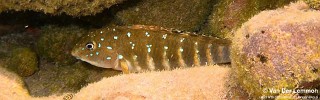
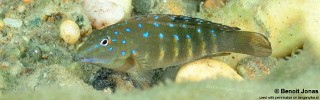
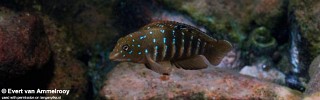
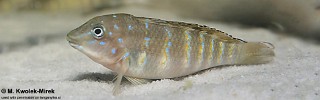
Tanganicodus irsacae occurs in Tanzania north of Kansombo, in the Democratic Republic of the
Congo north of Cape Caramba (Ubwari), and is also present in Burundi.
A similar form occurs between Moba and the Lunangwa River in the central part of the Democratic Republic of the
Congo and is referred to on this site as Tanganicodus cf. irsacae.
Typical adult size:
The smallest of the goby cichlids: up to 7 cm total length (females about 6 cm).
Sexual dimorphism:
No clear visual differences between male and female; the female is typically smaller.
Recommended aquarium size:
200 L for a well-bonded pair. If keeping more than a pair, a much larger aquarium is needed due
to intraspecific aggression (over 500 L).
Aquarium setup:
Fine sand combined with rocks; use rockwork to create several shelters and visual breaks. Provide
strong filtration flow to reflect the natural surge conditions.
It can be kept with other goby cichlids only when pairs are firmly established to avoid hybridization, or with
small lamprologine cichlids such as Julidochromis and Neolamprologus.
Diet:
Omnivorous, but primarily an invertebrate picker feeding on small invertebrates taken from aufwuchs,
with some algae also ingested. The pointed mouth allows it to extract prey from very narrow rock crevices.
The intestine is shorter than in other goby cichlids (about 1.5–2× body length).
Breeding:
Biparental mouthbrooder; both parents participate in incubation and territory defence. Spawning takes
place on a flat or slightly sloped rock. The female lays eggs and immediately collects them into her mouth; the
male releases sperm which the female also takes into her mouth, so fertilization occurs inside the female’s
mouth.
The female incubates eggs or young for about 10–14 days (until roughly 8–10 mm), then transfers them to
the male, who incubates for a further 7–8 days. The brooding parent does not eat, while the other feeds normally.
Brood size is usually up to about 20 young.
Aggression:
Extremely aggressive within the species; towards other species it is not strongly territorial. If
attempting to keep more than a pair, a large tank is required to manage aggression (over 500 L).
Special notes:
Considerable confusion exists around identification of Tanganicodus irsacae-like taxa, and
Spathodus erythrodon-like species are often misidentified as T. irsacae-like. A black
dorsal-fin spot is frequently assumed to be diagnostic, but it is not reliable: not all populations of
T. irsacae show the spot, and some S. erythrodon-like taxa can show a similar mark. Among
Eretmodus, Spathodus, and Tanganicodus, tooth morphology is stated as the only
consistent diagnostic character for separating the genera.
According to Ad Konings, the genus Tanganicodus contains a single species,
T. irsacae. In contrast, African Diving treat several geographically distinct
populations as potentially separate species or taxa, including:
Tanganicodus sp. 'Irsacae Udachi' (Udachi, south of Kansombo)
Tanganicodus sp. 'kavala' (south of Ubwari, from Kibanga Bay to the Kavala Islands), described as
lacking vertical body bars




A similar form occurs between Moba and the Lunangwa River in the central part of the Democratic Republic of the Congo and is referred to on this site as Tanganicodus cf. irsacae.
It can be kept with other goby cichlids only when pairs are firmly established to avoid hybridization, or with small lamprologine cichlids such as Julidochromis and Neolamprologus.
The intestine is shorter than in other goby cichlids (about 1.5–2× body length).
The female incubates eggs or young for about 10–14 days (until roughly 8–10 mm), then transfers them to the male, who incubates for a further 7–8 days. The brooding parent does not eat, while the other feeds normally. Brood size is usually up to about 20 young.
According to Ad Konings, the genus Tanganicodus contains a single species, T. irsacae. In contrast, African Diving treat several geographically distinct populations as potentially separate species or taxa, including:
Photo gallery