Muddy deep-water habitats.
During the day it occurs at depths down to about 160 m and migrates to
shallower water at night.
Geographic distribution:
Endemic to Lake Tanganyika with a lake-wide distribution in suitable
habitats.
Typical adult size:
Up to about 115 mm total length.
Sexual dimorphism:
No consistent differences in size or morphology between the sexes were
found by Poll, although later observations suggested males may be
smaller than females.
Diet:
Feeds on a wide range of food items, including juvenile cichlids,
shrimps, and phytoplankton.
Breeding:
Maternal mouthbrooder.
Females have been found carrying ripe eggs or larvae, and successful
breeding in the aquarium has been reported, with incubation lasting
about three weeks before fry are released.
Aggression:
Very timid and non-aggressive.
Special notes:
Distinguished from all other Trematocara species by having
17–21 branchiospines and five enlarged sensory pores on the infraorbitals.
Male coloration consists of a single black longitudinal band on the
dorsal and anal fins and a black line along the lower part of the body.
The species has appeared only briefly in the aquarium hobby and has
proven difficult to maintain long term.
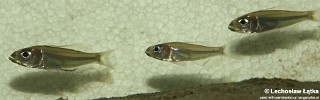
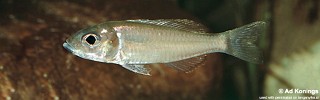
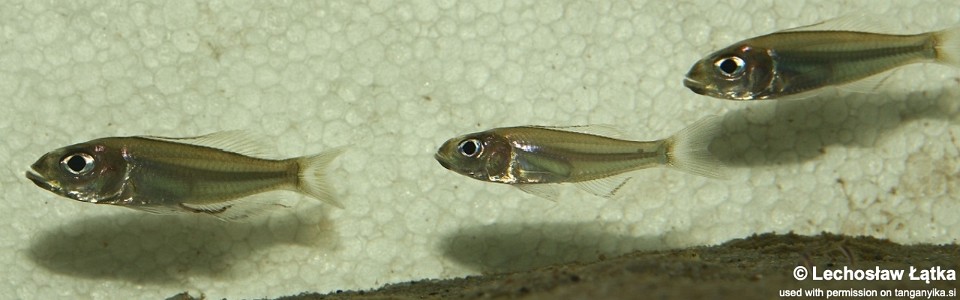




Photo gallery