Upper rocky littoral zone composed of solid rock and boulders, generally free of sediment.
The species inhabits shallow rocky coastlines with well-developed algal growth. In parts of its
range it occurs in contact zones with other Tropheus species, including areas where natural
hybridization takes place.
Geographic distribution:
Lake Tanganyika, along the central western Tanzanian coast. The natural distribution
extends from Lyamembe Bay in the south to Katumbi Point in the north. The lineage shows strong
geographic variation along this range.
Despite common references in the aquarium hobby, the form with two orange blotches is not
naturally found at Bulu Point or Karilani Island. The first population resembling the common
hobby form occurs approximately 26 km further south, at Nkwazi Point, south of Lubugwe Bay.
Many specimens reported from Karilani Island, Bulu Point and Katumbi Point represent displaced
individuals originating from within Mahale Mountains National Park, rather than native
populations.
Typical adult size:
Usually reaches 12–14 cm total length.
Sexual dimorphism:
Females remain smaller than males. No clear sex-specific differences in coloration are
described.
Recommended aquarium size:
An aquarium with a minimum volume of 500 liters and a length of at least 150 cm is recommended.
Aquarium setup:
Use fine sand as the substrate. To provide sufficient refuges for persecuted cichlids, place a substantial
number of rocks in the tank. It is advisable to use the rocks to create at least one, or several, visual
barriers. There are no plants in the natural habitat of Tropheus, so they are not required in the aquarium.
If plants are desired for aesthetic reasons or to slightly assist with water quality, choose species with
tougher leaves (Vallisneria, Anubias, Ceratophyllum, etc.), which are generally left untouched by Tropheus.
Water chemistry is of critical importance. The pH must be above 7.5 (approximately 7.5 to 9.5). Temperature
should be kept consistently between 24 and 27°C and must never exceed 29°C, as this can be fatal. Higher
temperatures increase oxygen demand while simultaneously reducing dissolved oxygen levels. In Lake
Tanganyika, the upper 40 m of water is very clear and rich in oxygen; therefore, the aquarium should also be
well oxygenated using air pumps, filter outlets directed toward the surface, or circulation pumps that
enhance surface agitation.
Tropheus are highly sensitive to ammonia, nitrite, and nitrate. The filtration system must therefore be
powerful and biologically mature. Ammonia and nitrite cause immediate poisoning, while elevated nitrate
levels lead to a gradual deterioration of health. Regular weekly water changes of 30–50% are essential, and
replacement water should also be well oxygenated.
It is practically impossible to recreate the natural environment of Tropheus in an aquarium, as this would
require an extremely large system. In the wild, most adult Tropheus are territorial; similarly, in the
aquarium one or a few territorial males occupy defined areas, leaving limited space for other males and
females. Because food availability in the aquarium is higher than in nature, non-territorial individuals
tend to suppress the need to establish separate feeding territories.
Tropheus are best maintained in relatively large groups of approximately 15 to 25 individuals. In such
groups, there may be several males, but there should be at least three to four females per male. Typically,
only one male becomes dominant, occupies a territory, and is the only individual that spawns.
In community aquaria, somewhat smaller groups may also be kept. Suitable tank mates include other
herbivorous Tanganyikan cichlids, such as smaller Petrochromis species, goby cichlids (Eretmodus,
Tanganicodus, and Spathodus)...
Different geographic variants of the same Tropheus species should never be kept together due to the high
risk of hybridization. Different Tropheus species may be kept together, preferably those that naturally
occur at the same locations. For example, T. duboisi can generally be housed with other Tropheus species,
although its lower aggressiveness often makes a species-only aquarium the better choice.
When establishing a group, it is best to introduce a larger number of juveniles so territories develop
gradually as the fish grow. Introducing adults often results in extremely violent territorial conflicts.
Adding Tropheus to an already established group with defined territories is also very difficult.
Diet:
Herbivorous. In the lake, Tropheus feed primarily on filamentous algae from the aufwuchs. In the
aquarium, some of these algae may grow on rocks, but usually not in sufficient quantity to form the main
diet. As a staple, flake food with a high spirulina content is most suitable. Occasionally, foods such as
Daphnia, Cyclops, and Mysis can be offered, as some of this prey is also ingested during natural algae
grazing.
High-protein foods must be strictly avoided, as they can be lethal. Tropheus have a very long digestive
tract adapted to a low-protein diet, and excessive protein intake can quickly lead to the condition known
as bloat, to which they are extremely susceptible.
Adult fish should be fed once per day, only as much as they can consume within two minutes. Feeding can
also be divided into several smaller meals per day, provided the total daily amount remains the same.
Breeding:
Typical mouthbrooders. Tropheus usually begin breeding at around 12 months of age, although some
individuals may start considerably later. Spawning begins with the dominant male chasing the female. In
the wild, breeding starts when a female enters the male’s territory and begins feeding there. In the
aquarium, the male’s territory often encompasses most or all of the tank, resulting in continuous chasing
of females, even when they are not yet sexually mature.
A receptive female responds to the male’s courtship displays and follows him to his territory. Spawning
usually occurs in the calmest part of the territory, often on a gently sloping surface. Eggs are laid one
at a time, immediately taken into the female’s mouth, and fertilized by the male during this process.
Eggs are relatively large (approximately 5–7 mm), resulting in small broods of about 6–16 eggs. The female
carries the developing fry for around 24–26 days, after which she gradually releases them and guards them
for several days. The male plays no role in brood care and often drives the female away immediately after
spawning.
Unlike many other mouthbrooding cichlids, female Tropheus continue to feed while carrying fry. In some
species, females may accept food without swallowing it, with the food consumed only by the fry, whereas in
other species females feed normally together with the fry.
Aggression:
Unlike most Haplochromis in Lake Tanganyika, female Tropheus also maintain feeding territories.
Male territories are generally one to two times larger than those of females.
In the aquarium, limited space usually allows only a few, or even a single, dominant male to hold a
territory, from which all other cichlids are chased away. Aggression is strongest toward conspecifics,
while other species are typically tolerated to a greater extent. Due to pronounced intraspecific
aggression, Tropheus should be kept in larger groups to distribute aggression among more individuals.
Special notes:
Tropheus sp. 'kirschfleck' is regarded by African Diving and on tanganyika.si
as a distinct species, separate from T. sp. 'black', while Ad Konings considers the
so-called "Kirschfleck moorii" to represent a geographic variant of T. sp. 'black'.
Another name used for this species, primarily by African Diving, is T. sp. 'Doubleblot';
on tanganyika.si the name T. sp. 'kirschfleck' is preferred, as it is more widely known
among aquarists.
A widespread misconception in the hobby concerns the origin of the two-blotch form commonly
labeled as "Bulu Point". The typical two orange blotches are not naturally present at Bulu
Point, Karilani Island or Katumbi Point. The first population resembling the hobby form is found
significantly further south, at Nkwazi Point. Specimens from Bulu Point and Karilani Island with
two orange blotches represent displaced fish, most of which originate from Mahale Mountains
National Park, where collecting is prohibited. As a result, fish exported under the false
locality name "Bulu Point" usually originate from various locations within the national park.
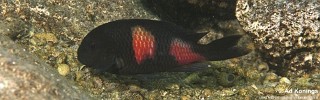
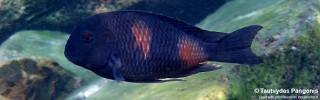
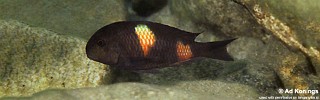
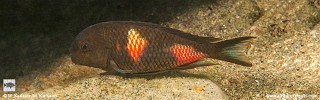
The species exhibits pronounced geographic variation in coloration along its natural range.
The most intense red individuals occur at the southernmost localities around Lyamembe, where
blotches vary greatly in shape and size and hybrids are common. Further north, between
Mankungwe and Lufungu Bay, populations display more uniform orange blotches; most specimens in the
aquarium hobby originate from Lumbye, Sisaba and Siyeswe bays within this section. North of
Lubugwe Bay the blotches become paler, more irregular, and increasingly white or grey with only
traces of red. Towards the northern limit near Bilinge Bay, the posterior blotch disappears and the
anterior blotch becomes very small, with many individuals showing an overall dark copper
coloration.
Rare, uniformly dark individuals from the same lineage may occur naturally at Karilani Island,
but not the characteristic two-blotch form known from the hobby. In the early 1990s African
Diving collected and exported a few such fish from Karilani Island under the name
Tropheus sp. 'Copper'.
Along its distribution T. sp. 'kirschfleck' shares habitat with several other Tropheus
species. Throughout its entire range it co-occurs with T. polli.
In the northern part of its range, between Bulu Point and Lufungu
Bay, it also shares habitat with T. sp. 'lukuga' (treated by Ad Konings as a variant of
T. brichardi). Between Luagala Point and Bulu Point it co-occurs with
T. duboisi, with no known hybrids involving these species.
In the southern part of its distribution, T. sp. 'kirschfleck' shares habitat with
T. sp. 'limespot'. These species co-occur at Lyamembe and Mabilibili Bay, where extensive
natural hybridization is documented. This area is the source of numerous hybrids, including the
form commonly referred to in the hobby as "Red Belly", a name that is considered misleading.
African Diving uses the name "Red blotch" for these hybrids, while information on the true
"Red Belly" remains unpublished. African Diving documented more than 40 different hybrid color
forms from this area, ranging from near-pure T. sp. 'kirschfleck' to near-pure
T. sp. 'limespot', with many intermediates.
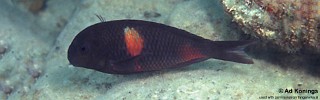
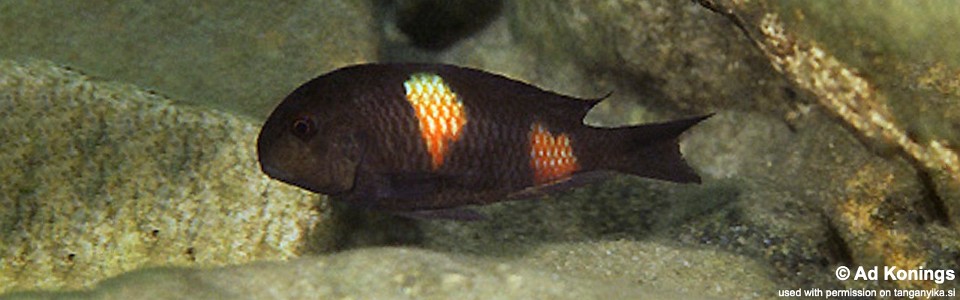




Despite common references in the aquarium hobby, the form with two orange blotches is not naturally found at Bulu Point or Karilani Island. The first population resembling the common hobby form occurs approximately 26 km further south, at Nkwazi Point, south of Lubugwe Bay.
Many specimens reported from Karilani Island, Bulu Point and Katumbi Point represent displaced individuals originating from within Mahale Mountains National Park, rather than native populations.
Water chemistry is of critical importance. The pH must be above 7.5 (approximately 7.5 to 9.5). Temperature should be kept consistently between 24 and 27°C and must never exceed 29°C, as this can be fatal. Higher temperatures increase oxygen demand while simultaneously reducing dissolved oxygen levels. In Lake Tanganyika, the upper 40 m of water is very clear and rich in oxygen; therefore, the aquarium should also be well oxygenated using air pumps, filter outlets directed toward the surface, or circulation pumps that enhance surface agitation.
Tropheus are highly sensitive to ammonia, nitrite, and nitrate. The filtration system must therefore be powerful and biologically mature. Ammonia and nitrite cause immediate poisoning, while elevated nitrate levels lead to a gradual deterioration of health. Regular weekly water changes of 30–50% are essential, and replacement water should also be well oxygenated.
It is practically impossible to recreate the natural environment of Tropheus in an aquarium, as this would require an extremely large system. In the wild, most adult Tropheus are territorial; similarly, in the aquarium one or a few territorial males occupy defined areas, leaving limited space for other males and females. Because food availability in the aquarium is higher than in nature, non-territorial individuals tend to suppress the need to establish separate feeding territories.
Tropheus are best maintained in relatively large groups of approximately 15 to 25 individuals. In such groups, there may be several males, but there should be at least three to four females per male. Typically, only one male becomes dominant, occupies a territory, and is the only individual that spawns.
In community aquaria, somewhat smaller groups may also be kept. Suitable tank mates include other herbivorous Tanganyikan cichlids, such as smaller Petrochromis species, goby cichlids (Eretmodus, Tanganicodus, and Spathodus)...
Different geographic variants of the same Tropheus species should never be kept together due to the high risk of hybridization. Different Tropheus species may be kept together, preferably those that naturally occur at the same locations. For example, T. duboisi can generally be housed with other Tropheus species, although its lower aggressiveness often makes a species-only aquarium the better choice.
When establishing a group, it is best to introduce a larger number of juveniles so territories develop gradually as the fish grow. Introducing adults often results in extremely violent territorial conflicts. Adding Tropheus to an already established group with defined territories is also very difficult.
High-protein foods must be strictly avoided, as they can be lethal. Tropheus have a very long digestive tract adapted to a low-protein diet, and excessive protein intake can quickly lead to the condition known as bloat, to which they are extremely susceptible.
Adult fish should be fed once per day, only as much as they can consume within two minutes. Feeding can also be divided into several smaller meals per day, provided the total daily amount remains the same.
A receptive female responds to the male’s courtship displays and follows him to his territory. Spawning usually occurs in the calmest part of the territory, often on a gently sloping surface. Eggs are laid one at a time, immediately taken into the female’s mouth, and fertilized by the male during this process.
Eggs are relatively large (approximately 5–7 mm), resulting in small broods of about 6–16 eggs. The female carries the developing fry for around 24–26 days, after which she gradually releases them and guards them for several days. The male plays no role in brood care and often drives the female away immediately after spawning.
Unlike many other mouthbrooding cichlids, female Tropheus continue to feed while carrying fry. In some species, females may accept food without swallowing it, with the food consumed only by the fry, whereas in other species females feed normally together with the fry.
In the aquarium, limited space usually allows only a few, or even a single, dominant male to hold a territory, from which all other cichlids are chased away. Aggression is strongest toward conspecifics, while other species are typically tolerated to a greater extent. Due to pronounced intraspecific aggression, Tropheus should be kept in larger groups to distribute aggression among more individuals.
A widespread misconception in the hobby concerns the origin of the two-blotch form commonly labeled as "Bulu Point". The typical two orange blotches are not naturally present at Bulu Point, Karilani Island or Katumbi Point. The first population resembling the hobby form is found significantly further south, at Nkwazi Point. Specimens from Bulu Point and Karilani Island with two orange blotches represent displaced fish, most of which originate from Mahale Mountains National Park, where collecting is prohibited. As a result, fish exported under the false locality name "Bulu Point" usually originate from various locations within the national park.
The species exhibits pronounced geographic variation in coloration along its natural range. The most intense red individuals occur at the southernmost localities around Lyamembe, where blotches vary greatly in shape and size and hybrids are common. Further north, between Mankungwe and Lufungu Bay, populations display more uniform orange blotches; most specimens in the aquarium hobby originate from Lumbye, Sisaba and Siyeswe bays within this section. North of Lubugwe Bay the blotches become paler, more irregular, and increasingly white or grey with only traces of red. Towards the northern limit near Bilinge Bay, the posterior blotch disappears and the anterior blotch becomes very small, with many individuals showing an overall dark copper coloration.
Rare, uniformly dark individuals from the same lineage may occur naturally at Karilani Island, but not the characteristic two-blotch form known from the hobby. In the early 1990s African Diving collected and exported a few such fish from Karilani Island under the name Tropheus sp. 'Copper'.
Along its distribution T. sp. 'kirschfleck' shares habitat with several other Tropheus species. Throughout its entire range it co-occurs with T. polli. In the northern part of its range, between Bulu Point and Lufungu Bay, it also shares habitat with T. sp. 'lukuga' (treated by Ad Konings as a variant of T. brichardi). Between Luagala Point and Bulu Point it co-occurs with T. duboisi, with no known hybrids involving these species.
In the southern part of its distribution, T. sp. 'kirschfleck' shares habitat with T. sp. 'limespot'. These species co-occur at Lyamembe and Mabilibili Bay, where extensive natural hybridization is documented. This area is the source of numerous hybrids, including the form commonly referred to in the hobby as "Red Belly", a name that is considered misleading. African Diving uses the name "Red blotch" for these hybrids, while information on the true "Red Belly" remains unpublished. African Diving documented more than 40 different hybrid color forms from this area, ranging from near-pure T. sp. 'kirschfleck' to near-pure T. sp. 'limespot', with many intermediates.
Photo gallery