
Lake Tanganyika cichlids — species, locations & maps
Lake Tanganyika cichlids — species, locations & maps
tanganyika.si
Lake Tanganyika cichlids — species, locations & maps.
All images are used with permission of the authors. Unauthorized use is prohibited.
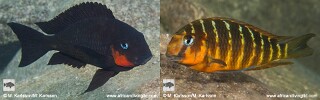
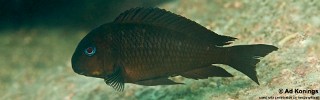
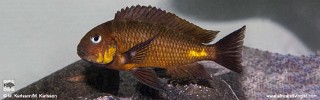
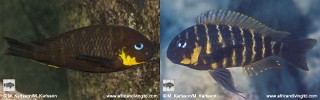



Water chemistry is of critical importance. The pH must be above 7.5 (approximately 7.5 to 9.5). Temperature should be kept consistently between 24 and 27°C and must never exceed 29°C, as this can be fatal. Higher temperatures increase oxygen demand while simultaneously reducing dissolved oxygen levels. In Lake Tanganyika, the upper 40 m of water is very clear and rich in oxygen; therefore, the aquarium should also be well oxygenated using air pumps, filter outlets directed toward the surface, or circulation pumps that enhance surface agitation.
Tropheus are highly sensitive to ammonia, nitrite, and nitrate. The filtration system must therefore be powerful and biologically mature. Ammonia and nitrite cause immediate poisoning, while elevated nitrate levels lead to a gradual deterioration of health. Regular weekly water changes of 30–50% are essential, and replacement water should also be well oxygenated.
It is practically impossible to recreate the natural environment of Tropheus in an aquarium, as this would require an extremely large system. In the wild, most adult Tropheus are territorial; similarly, in the aquarium one or a few territorial males occupy defined areas, leaving limited space for other males and females. Because food availability in the aquarium is higher than in nature, non-territorial individuals tend to suppress the need to establish separate feeding territories.
Tropheus are best maintained in relatively large groups of approximately 15 to 25 individuals. In such groups, there may be several males, but there should be at least three to four females per male. Typically, only one male becomes dominant, occupies a territory, and is the only individual that spawns.
In community aquaria, somewhat smaller groups may also be kept. Suitable tank mates include other herbivorous Tanganyikan cichlids, such as smaller Petrochromis species, goby cichlids (Eretmodus, Tanganicodus, and Spathodus)...
Different geographic variants of the same Tropheus species should never be kept together due to the high risk of hybridization. Different Tropheus species may be kept together, preferably those that naturally occur at the same locations. For example, T. duboisi can generally be housed with other Tropheus species, although its lower aggressiveness often makes a species-only aquarium the better choice.
When establishing a group, it is best to introduce a larger number of juveniles so territories develop gradually as the fish grow. Introducing adults often results in extremely violent territorial conflicts. Adding Tropheus to an already established group with defined territories is also very difficult.
High-protein foods must be strictly avoided, as they can be lethal. Tropheus have a very long digestive tract adapted to a low-protein diet, and excessive protein intake can quickly lead to the condition known as bloat, to which they are extremely susceptible.
Adult fish should be fed once per day, only as much as they can consume within two minutes. Feeding can also be divided into several smaller meals per day, provided the total daily amount remains the same.
A receptive female responds to the male’s courtship displays and follows him to his territory. Spawning usually occurs in the calmest part of the territory, often on a gently sloping surface. Eggs are laid one at a time, immediately taken into the female’s mouth, and fertilized by the male during this process.
Eggs are relatively large (approximately 5–7 mm), resulting in small broods of about 6–16 eggs. The female carries the developing fry for around 24–26 days, after which she gradually releases them and guards them for several days. The male plays no role in brood care and often drives the female away immediately after spawning.
Unlike many other mouthbrooding cichlids, female Tropheus continue to feed while carrying fry. In some species, females may accept food without swallowing it, with the food consumed only by the fry, whereas in other species females feed normally together with the fry.
In the aquarium, limited space usually allows only a few, or even a single, dominant male to hold a territory, from which all other cichlids are chased away. Aggression is strongest toward conspecifics, while other species are typically tolerated to a greater extent. Due to pronounced intraspecific aggression, Tropheus should be kept in larger groups to distribute aggression among more individuals.
The species has been discussed as possibly having a hybrid origin. One proposed scenario involves T. sp. 'kipili' (or a close ancestor) together with a T. moorii-like lineage comparable to the cross-lake form known as T. sp. 'limespot'. A red-cheek population at Katondo has also been cited as suggestive that ancestry related to T. sp. 'kirschfleck' could be involved in past hybridization.
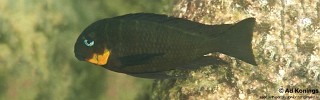
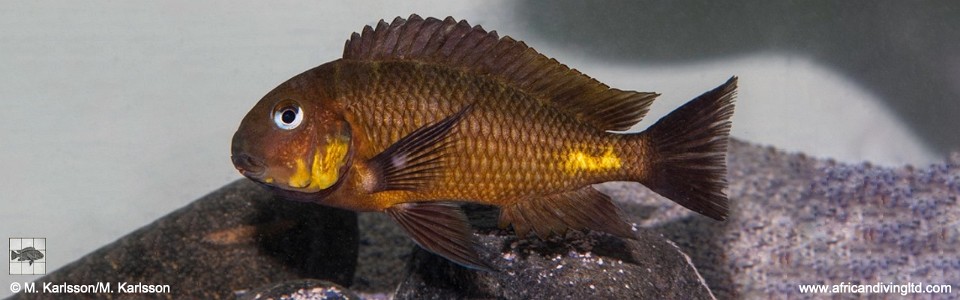
Several named or well-known local variants are mentioned along the distribution:
- Korongwe Bay (Mwala Hills / Mwaka area) – African Diving reported a form they named
"Dahabu Yellow Cheek". In Korongwe Bay there are indications of more recent hybridization
between this population and T. sp. 'kipili' from across the bay.
- Katondo Point – a red-cheek variant occurs here.
- Shanshete – Konings reported "Yellow Cheek" from this locality, but African Diving
stated that the Shanshete fish differ from the Mwala Hills population, with a smaller cheek
patch that may be yellowish, orange, or reddish.
- Kolwe Point – African Diving described a population nicknamed "Caudal Stripe", with
a horizontal yellow stripe on the caudal peduncle (about 3–4 mm thick) and a yellow cheek
patch.
- Kemp – a very dark form was reported, with a greyish-white cheek according to
African Diving.
- North of Cape Mpimbwe – additional populations are described as very dark, nearly
black.
An exceptionally rare color morph, "Golden Kushangaza", is described as a bright yellow aberrant form occurring within the otherwise dark T. sp. 'mpimbwe' populations. The first known specimen was reportedly collected on 11 April 1990 by African Diving diver Yusuph Maridadi, and additional occurrences were later reported from other localities within the species’ range.Photo gallery