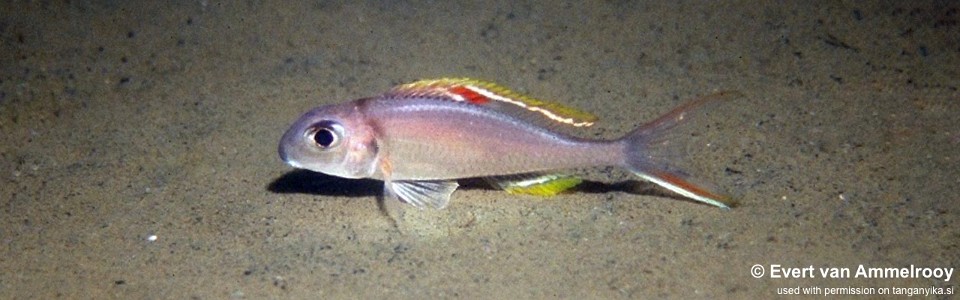
Xenotilapia nigrolabiata 'Chituta Bay' Red Princess
Tribe / Genus:
Ectodini / Xenotilapia
Type locality:
Msamba, Lake Tanganyika
Biotope:
Deep sandy or muddy bottoms. Most commonly found at depths around
60 m, but recorded as deep as 170 m.
Geographic distribution:
Endemic to Lake Tanganyika with a lake-wide distribution. Some geographic
variation is present, mainly expressed in the size of the red blotch in
the dorsal fin.
Typical adult size:
Males reach up to about 13 cm total length, while females remain
slightly smaller, usually up to around 11 cm.
Recommended aquarium size:
Approximately 250 liters, with a minimum aquarium length of
120–130 cm.
Aquarium setup:
Fine sand substrate, preferably not too light in color, combined with a
few smooth rocks without sharp edges. Excellent water quality is
essential and should be maintained through efficient filtration and
weekly water changes. Lighting should initially be kept dim.
Best maintained in a species-only aquarium, as this species is easily
stressed and can be dominated by more aggressive or territorial fishes.
Diet:
Carnivorous. Feeds mainly on small crustaceans and other invertebrates.
Unlike many congeners, it usually forages from the upper layer of the
substrate and only rarely pushes its head deep into the sand.
Breeding:
Maternal mouthbrooder. Spawning occurs on open sandy or muddy substrate,
without construction of any nest or sand-scrape. Clutch size is small,
usually around 10–15 eggs. The female incubates eggs and larvae for about
15–21 days. Upon release the fry are already free-swimming, and no
post-release brood care is provided.
Aggression:
Generally peaceful, both toward conspecifics and other species.
Special notes:
Easily distinguished from all other species of Xenotilapia
by the presence of tricuspid teeth on the jaws.
Previously referred to as the undescribed
Xenotilapia sp. “Red Princess”, but later shown to represent a
geographical variant of Xenotilapia nigrolabiata.




Best maintained in a species-only aquarium, as this species is easily stressed and can be dominated by more aggressive or territorial fishes.
Previously referred to as the undescribed Xenotilapia sp. “Red Princess”, but later shown to represent a geographical variant of Xenotilapia nigrolabiata.
Photo gallery