Likely occurs in open water close to shore where the bottom drops off
steeply, and is associated with deeper zones reported between roughly
15–100 meters.
Geographic distribution:
The type locality is at Moba (DR Congo). The few specimens collected for
the aquarium trade were reported from just south of Moba down toward
Zambia. It remains uncertain whether the species is distributed lake-wide. Depth
has been reported as 15–100 meters in the original description, while
other sources cite 40–100 meters.
Typical adult size:
Up to about 23 cm (excluding the caudal-fin filament).
Recommended aquarium size:
Minimum 380 liters.
Aquarium setup:
Provide plenty of open space with only a few large, smooth stones or slate.
Because too few have been exported to judge long-term compatibility, and
because individuals may attack tankmates, a divider method has been
suggested as a practical way to manage aggression and potential scale
damage, especially if breeding is attempted.
Diet:
A specialized scale- and skin-eater. It has been reported that roughly
half of the diet is fish skin and half scales, mainly taken from the two
Lake Tanganyika sardine species.
In larger individuals, it has also been suggested that it may take scales
from Benthochromis tricoti and Benthochromis horii, in line with the
proposed mimicry of these species’ overall coloration.
Breeding:
Mouthbrooder. Whether incubation is performed by the female alone or shared
by both parents is not known.
Aggression:
Not well documented in general due to limited observations, but at least
one aquarium-held individual was reported to attack a deep-bodied fish
shortly after introduction, consistent with a lepidophagous lifestyle.
Special notes:
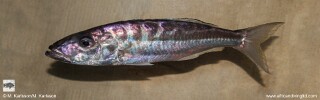
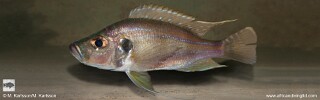
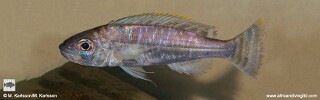
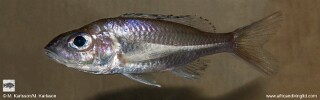
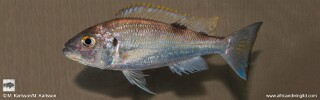
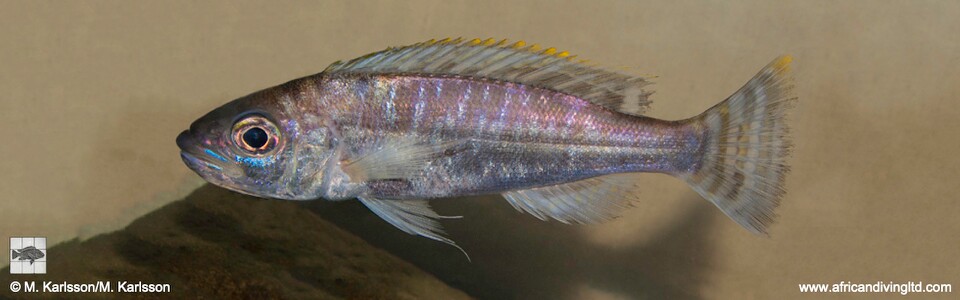
Similar in overall body form to Plecodus paradoxus,
but smaller-growing, with more elaborate finnage and more complex body and
fin coloration. It is reported as the only known cichlid to develop a
filament exclusively on the lower lobe of the caudal fin.




Because too few have been exported to judge long-term compatibility, and because individuals may attack tankmates, a divider method has been suggested as a practical way to manage aggression and potential scale damage, especially if breeding is attempted.
In larger individuals, it has also been suggested that it may take scales from Benthochromis tricoti and Benthochromis horii, in line with the proposed mimicry of these species’ overall coloration.
Photo gallery