Albertville, Lake Tanganyika, Democratic Republic of Congo
Biotope:
Shallow intermediate habitats of Lake Tanganyika, occurring mainly near river mouths,
lagoons, and swampy inshore areas with sandy or muddy substrates.
Geographic distribution:
Lake Tanganyika and adjacent river systems connected to the lake, particularly near
inflowing and outflowing rivers.
Typical adult size:
Up to about 33 cm total length.
Sexual dimorphism:
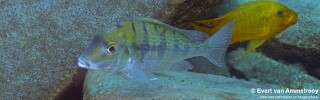
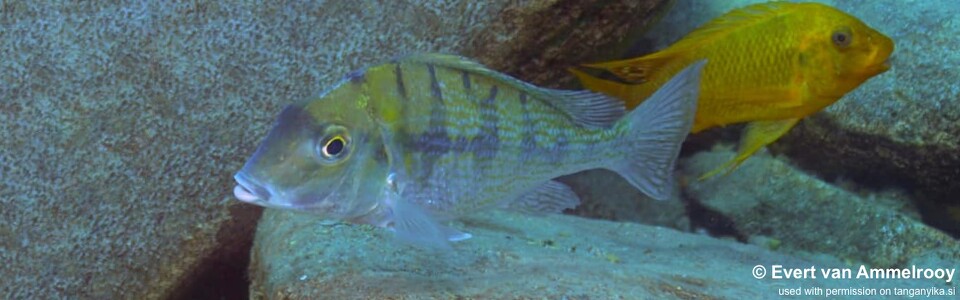
Differences between the sexes are minimal. Males show a golden nape and shoulder
separated from the silvery flank by a dark bar, while females are silvery with faint
vertical barring. There is no size difference between sexes.
Diet:
Generalized benthic feeder. Consumes invertebrates, including small mollusks, and
ingests sand while feeding from the bottom; higher plants such as Vallisneria
may also be taken.
Breeding:
Maternal mouthbrooder. Spawning occurs without defended territories; the male courts
the female with brief quivering displays. Females have been found holding up to
100–300 eggs or fry, which are released after a brooding period of about three weeks.
Aggression:
Males are not territorial and do not construct or defend spawning sites. Mouthbrooding
females may gather in large groups.
Special notes:
Often regarded as transitional between riverine and lacustrine cichlids, occurring in
the lake mainly near river mouths but also upstream in rivers.
Molecular studies indicate that this species colonized Lake Tanganyika relatively
recently and evolved outside the lake’s main endemic radiations.





Molecular studies indicate that this species colonized Lake Tanganyika relatively recently and evolved outside the lake’s main endemic radiations.
Photo gallery