Central Tanzania, between Karema and Kampemba Point. It occurs sympatrically with
N. sp. ‘eseki’ throughout its geographic range. No modestus-like species have been observed
between Kampemba Point and Mbofula Points (about 40 km of coastline).
Typical adult size:
Up to around 12 cm.
Sexual dimorphism:
No clear sexual dimorphism; males are larger than females and develop a more pronounced head
hump.
Recommended aquarium size:
200 L (for an established pair); larger aquaria are recommended for group setups.
Aquarium setup:
Use several distinct larger rock piles and fine sand as substrate. For group aquaria, a tank
larger than 200 L is recommended.
Diet:
Carnivorous; mainly feeds on various invertebrates and occasionally on small snails.
Breeding:
Breeds throughout the year. A high reproductive output is reported, with approximately
200–500 eggs per spawning. In the wild, males may live in a harem with 2–5 females, while in aquaria
the species typically forms pairs and the male is described as relatively tolerant toward the female.
Aggression:
Generally calmer than N. christyi, but it defends its territory very actively,
especially when guarding eggs and fry.
Special notes:
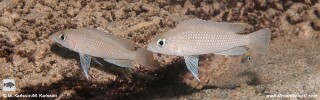
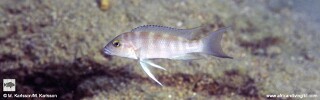
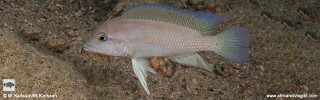
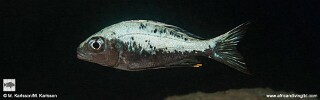
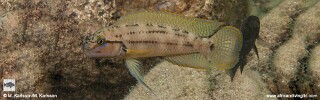
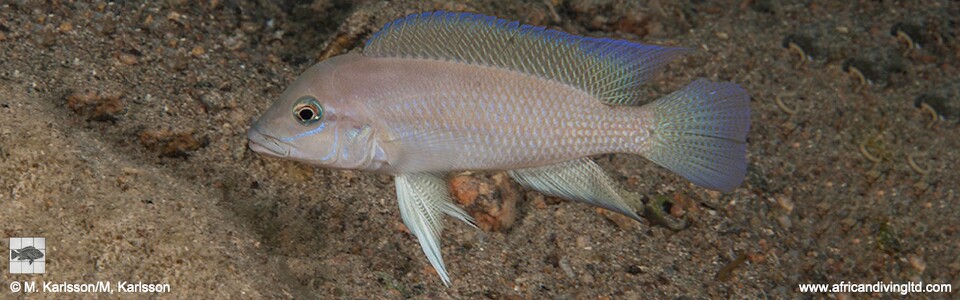
Neolamprologus sp. ‘modestus mpimbwe’ is a modestus-like form that has been
erroneously referred to as N. mondabu in the literature. A provisional description includes a
brown, beige, or slightly bluish beige body. The dorsal and caudal fins are yellowish brown to
yellowish beige, each with a very thin yellow margin and a blue submargin; the blue submargin is
medium thick on the dorsal fin and usually very thick and indistinct on the caudal fin. The pelvic
fins and anal fin are brown or beige, the pectoral fins are hyaline greyish, and the other fins are
described as pearly in appearance. Adult specimens develop a frontal hump, an indented lower head
profile, and a moderately elongated snout.
Compared to true N. modestus, which is characterised as a black, dark brown, or
beige species with bright yellow pectoral fins and a rounded or subtruncate caudal fin with rounded
corners, this form is distinguished by its bluish tones and blue submargins in the dorsal and caudal
fins, hyaline greyish pectorals, and a more truncate or straight-cut caudal fin with slightly rounded
corners. In addition, unlike true N. modestus and its southern variants, it has not been
observed beating the caudal fin on sandy or sediment-rich substrate to expose prey.
Compared to N. sp. ‘modestus mahale’, this form differs primarily in fin coloration. In
N. sp. ‘modestus mahale’, the dorsal fin has an orange margin and lilac submargin with an
additional orange horizontal stripe below, while the caudal fin shows an orange margin and lilac
submargin with an orange vertical stripe or diffuse field posterior to that submargin. The caudal-fin
margin in that form extends across the entire fin and the fin is not divided into upper and lower
parts, unlike many southern N. modestus variants. Both N. sp. ‘modestus mpimbwe’ and
N. sp. ‘modestus mahale’ have not been observed uncovering prey by beating the caudal fin.




Compared to true N. modestus, which is characterised as a black, dark brown, or beige species with bright yellow pectoral fins and a rounded or subtruncate caudal fin with rounded corners, this form is distinguished by its bluish tones and blue submargins in the dorsal and caudal fins, hyaline greyish pectorals, and a more truncate or straight-cut caudal fin with slightly rounded corners. In addition, unlike true N. modestus and its southern variants, it has not been observed beating the caudal fin on sandy or sediment-rich substrate to expose prey.
Compared to N. sp. ‘modestus mahale’, this form differs primarily in fin coloration. In N. sp. ‘modestus mahale’, the dorsal fin has an orange margin and lilac submargin with an additional orange horizontal stripe below, while the caudal fin shows an orange margin and lilac submargin with an orange vertical stripe or diffuse field posterior to that submargin. The caudal-fin margin in that form extends across the entire fin and the fin is not divided into upper and lower parts, unlike many southern N. modestus variants. Both N. sp. ‘modestus mpimbwe’ and N. sp. ‘modestus mahale’ have not been observed uncovering prey by beating the caudal fin.
Photo gallery